Art Is Not Decoration: It Is Memory
There is a shallow way of looking at art that has become too common in our time. It is the habit of seeing art merely as decoration—something placed on a wall to beautify a room, something performed on a stage to entertain an audience, something written in a book to occupy leisure, something carved, painted, sung, danced, or dramatized to provide temporary pleasure.
LIFE
Iyorwuese Hagher
5/17/20267 min read
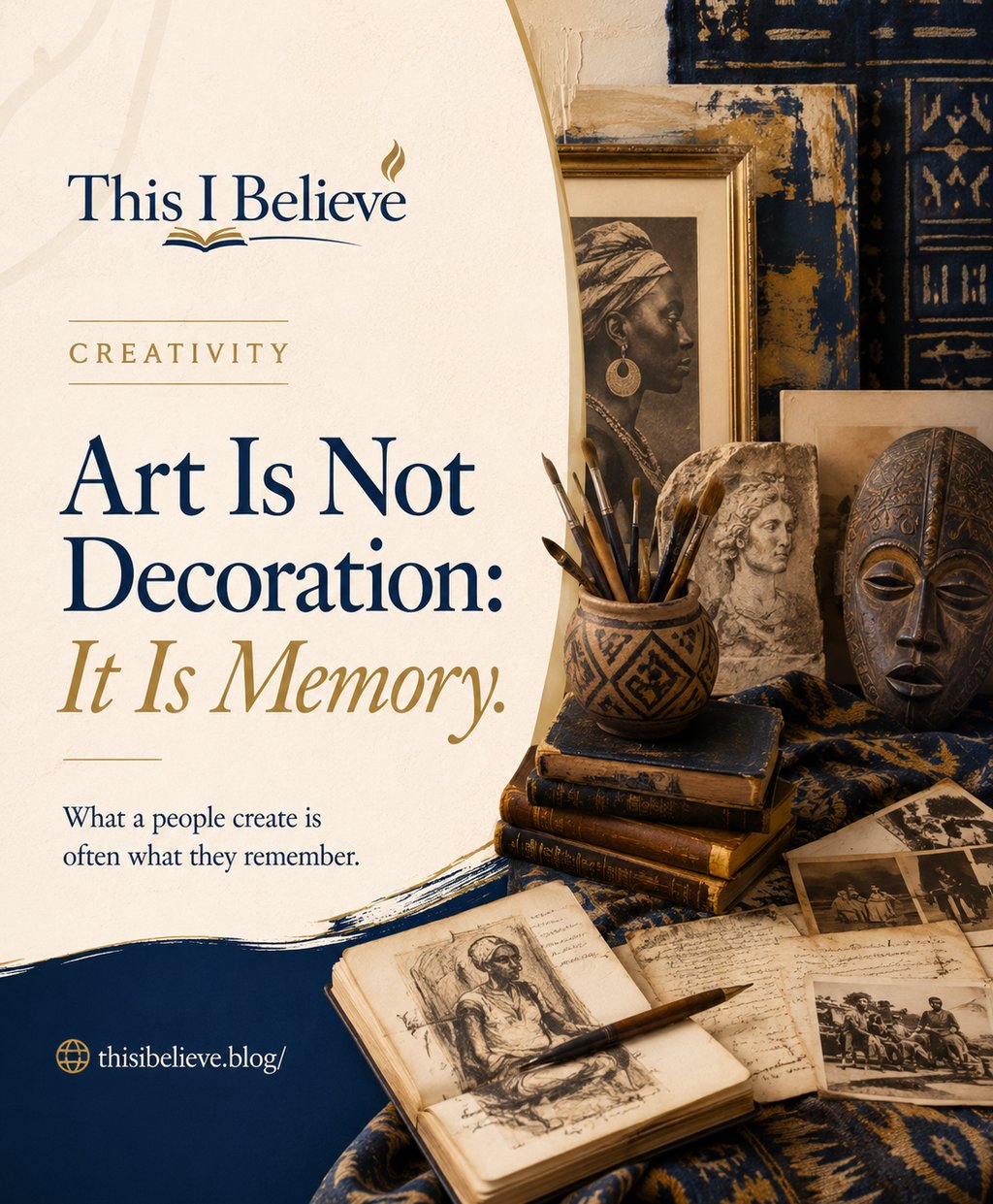
There is a shallow way of looking at art that has become too common in our time. It is the habit of seeing art merely as decoration—something placed on a wall to beautify a room, something performed on a stage to entertain an audience, something written in a book to occupy leisure, something carved, painted, sung, danced, or dramatized to provide temporary pleasure.
This view is not only poor; it is dangerous.
Art is not decoration. Art is memory.
It is the memory of a people, the archive of their struggles, the shape of their imagination, the voice of their ancestors, and the mirror through which a society examines itself. Long after politicians have left office, long after speeches have faded, long after buildings have collapsed and empires have disappeared, art remains as witness. It tells the future that a people once lived, loved, suffered, believed, resisted, danced, mourned, prayed, and dreamed.
A society that treats art as decoration has already begun to lose its soul.
The greatest civilizations did not survive in memory only because of their armies or markets. They survived because they left behind songs, sculptures, architecture, myths, drama, literature, textiles, paintings, festivals, proverbs, and rituals of meaning. Through art, the dead continue to speak. Through art, the unborn are prepared to understand where they came from. Through art, a people refuse disappearance.
This is why art must be defended.
In Africa, art has never been separate from life. It was not created merely for galleries or elite salons. It lived in the marketplace, the shrine, the family compound, the moonlight square, the funeral ground, the farm, the palace, the festival, the naming ceremony, the wedding, the masquerade, the drumbeat, the folktale, and the proverb. Art was how the community remembered itself.
The drum was not only sound. It was message.
The mask was not only costume. It was presence.
The dance was not only movement. It was history.
The story was not only entertainment. It was instruction.
The song was not only melody. It was emotional truth.
This is the African genius: the refusal to separate beauty from meaning. In our older traditions, art carried memory, morality, warning, healing, and communal identity. It reminded the individual that he belonged to a story larger than himself. It taught children the names of heroes, the dangers of greed, the shame of cowardice, the dignity of courage, and the sacredness of community.
When a grandmother told a story under the moonlight, she was not merely passing time. She was transmitting civilization.
Today, however, many societies are becoming forgetful. We are surrounded by images, but we are losing vision. We consume music, but we often miss meaning. We celebrate performance, but neglect memory. We reward spectacle, but abandon depth. We have many platforms, but fewer sacred archives. The loudness of the digital age has multiplied expression while weakening reflection.
This is why the artist’s responsibility has become urgent.
The artist must not merely decorate the emptiness of the age. He must recover memory. He must remind society of what it is trying to forget. He must bring back buried questions, silenced voices, abandoned values, and historical wounds that power would prefer to erase. He must give form to experiences that ordinary speech cannot fully carry.
There are pains that only poetry can hold.
There are injustices that only drama can expose.
There are memories that only music can awaken.
There are truths that only painting, sculpture, dance, and story can make visible.
Art gives body to the invisible.
It makes memory touchable, hearable, seeable, and shareable. It transforms private grief into public recognition. It turns suffering into testimony. It rescues forgotten lives from silence. It allows a people to look at themselves and say, “This is who we were. This is what happened to us. This is what we must not become again.”
For this reason, art is closely related to truth.
Not the narrow truth of statistics alone, though statistics have their place. Not the official truth written in government documents alone, though archives are important. Art carries another kind of truth—the emotional truth of lived experience. It preserves the atmosphere of a time: the fear in the streets, the hope in the village, the hunger in the home, the arrogance of power, the resilience of mothers, the laughter of children, the silence of the oppressed.
A nation may produce official reports and still hide its wounds. But a serious work of art can expose what official language conceals.
This is why dictators fear artists. They may tolerate decorators, entertainers, and praise singers. But they fear the artist who remembers. They fear the poet who names oppression. They fear the playwright who unmasks hypocrisy. They fear the novelist who records the inner life of a broken society. They fear the singer whose melody becomes the anthem of a wounded people.
Power often wants forgetfulness. Art insists on memory.
In Nigeria, our national life has produced too much that must not be forgotten. We have known colonial disruption, civil war, military rule, corruption, displacement, religious violence, ethnic suspicion, poverty, insecurity, and repeated betrayals of public trust. Yet we have also known extraordinary resilience, humour, creativity, faith, intellectual brilliance, communal generosity, and stubborn hope.
Who will keep these memories alive if artists surrender their calling?
Who will tell the child of tomorrow what the mother of today endured?
Who will give language to the farmer driven from his land, the student betrayed by a broken system, the widow abandoned by justice, the young person struggling to believe in the country, the elder watching values collapse?
Art must not look away.
This does not mean every artist must become a political commentator. It means every serious artist must understand that creation is never innocent of memory. Even silence in art says something. Even beauty carries history. Even laughter can be an act of survival. Even love songs may carry the hidden wounds of a generation.
The question is not whether art speaks. Art always speaks. The question is whether it speaks truthfully.
There is also a danger when art is reduced only to commerce. Of course, artists must live. They must be paid. Their labour must be respected. A society that expects artists to starve while entertaining it is unjust. But when art becomes only a product, it begins to lose its moral depth. It chases trends. It imitates whatever sells. It abandons the long memory of the people for the short applause of the market.
The market asks, “Will it sell?”
Memory asks, “Will it endure?”
The serious artist must listen to both questions, but must not allow the first to murder the second.
Art that endures is not always the loudest in its own time. Sometimes it is misunderstood. Sometimes it is ignored by the crowd. Sometimes it appears too serious for an age addicted to speed. But true art has patience. It waits for history. It waits for the wounded to recognize themselves. It waits for the unborn to discover its necessity.
This is why artists must be disciplined. Talent is not enough. Beauty is not enough. Technique is not enough. The artist must cultivate conscience. He must study his people. He must listen deeply. He must understand history. He must honour language. He must resist the temptation to create only for applause. He must know that he is not merely making objects; he is shaping memory.
Art is a sacred trust.
A careless artist can distort memory. He can flatter power. He can promote falsehood. He can turn suffering into spectacle. He can make cruelty fashionable. He can help a society forget what it should remember. This is why artistic freedom must walk with artistic responsibility.
To create is to bear witness.
And witness must not be dishonest.
In many African communities, the artist was not simply an isolated genius. He was part of the moral and spiritual fabric of the community. The praise singer preserved genealogy. The storyteller preserved ethics. The drummer announced history. The sculptor shaped the sacred. The dancer embodied collective memory. The dramatist exposed folly through performance. Each artistic form had a social function.
Modernity must not rob art of this depth.
We may use digital tools, global platforms, cinematic technology, artificial intelligence, and modern publishing systems. These are instruments. They are not enemies. But tools cannot replace soul. Technology can amplify art, but it cannot give memory to an artist who has none. A beautiful design without cultural depth is only surface. A viral song without moral weight may disappear as quickly as it arrived.
The future needs artists who can combine modern skill with ancestral depth.
It needs writers who remember.
Painters who remember.
Musicians who remember.
Filmmakers who remember.
Dancers who remember.
Designers who remember.
Memory is not backwardness. It is foundation. A tree does not despise its roots because it wants to grow tall. A river does not deny its source because it wants to travel far. A people who forget their memory become available for every form of manipulation. They become easy to rename, easy to confuse, easy to divide, easy to sell.
Art protects a people from that danger.
It teaches us that identity is not only what is written on official documents. Identity is what is sung, told, carved, danced, painted, performed, and remembered across generations. It is the moral sound of a people’s journey through time.
Therefore, when we look at a painting, we must ask what memory it carries. When we hear a song, we must ask what wound or hope it preserves. When we read a novel, we must ask what human truth it rescues. When we watch a play, we must ask what society it is revealing to us. When we encounter a sculpture, a textile, a festival, a film, or a poem, we must ask: what part of us is speaking here?
This is the serious way to approach art.
Not as decoration.
Not as noise.
Not as mere entertainment.
But as memory.
A nation that remembers through art becomes more difficult to destroy. It may suffer, but it will not easily disappear. It may be wounded, but it will retain language for healing. It may be misgoverned, but it will preserve imagination for renewal.
Art keeps the soul awake.
And in a world that forgets too quickly, this may be one of the highest responsibilities of creativity: to ensure that what must be remembered is not buried by time, power, fashion, or silence.
For art is not decoration.
It is memory made visible.