
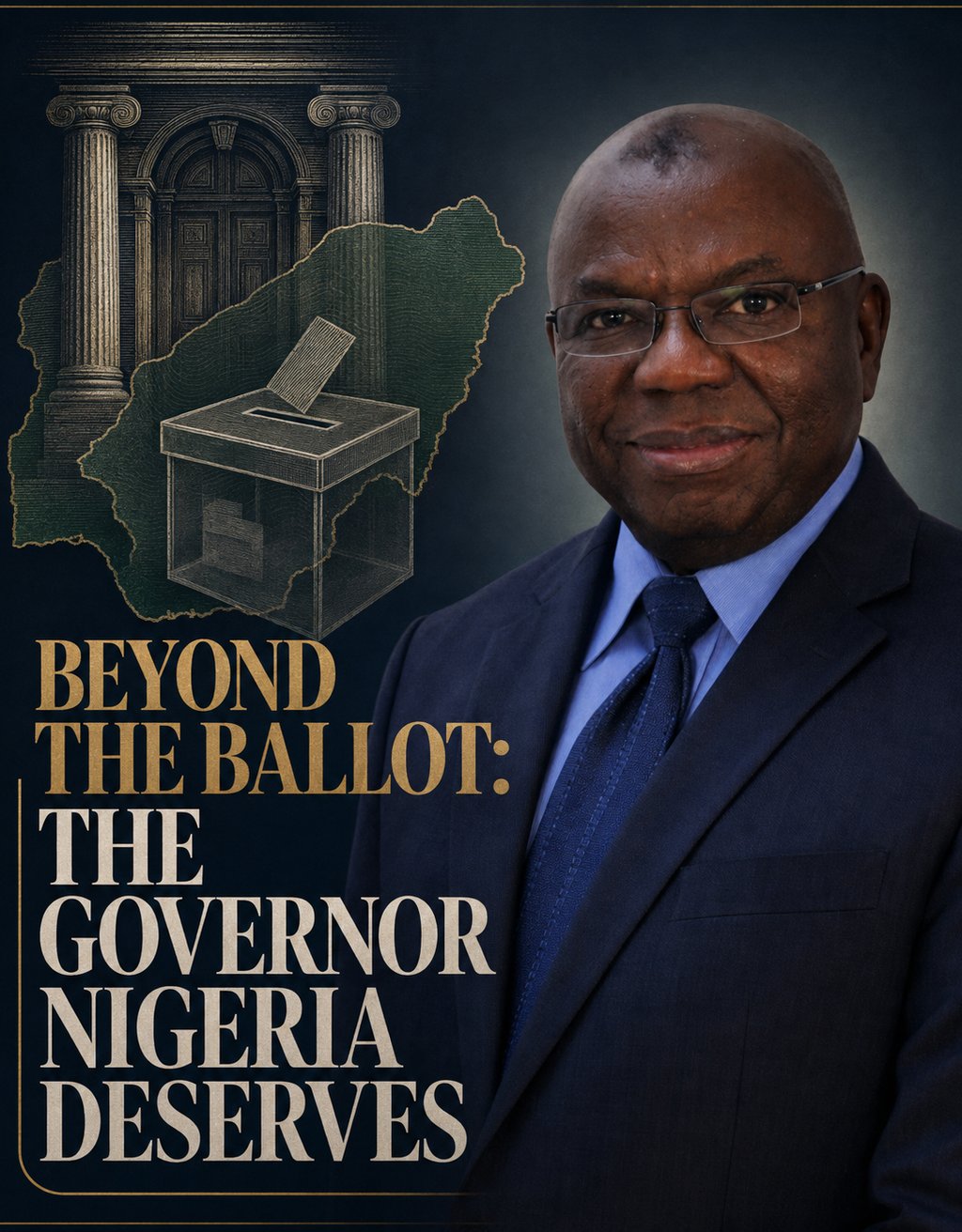
BEYOND THE BALLOT: A 2027 BUCKET LIST FOR THE GOVERNOR NIGERIA DESERVES
As Nigeria approaches 2027, voters must look beyond political parties, campaign promises and the money shared during elections. We must reject candidates who are habitual liars, corrupt, surrounded by cronies, persistently incompetent, driven by vanity and trivial pursuits, or controlled by unaccountable spiritual manipulators.
NATIONHOODGENERALLEADERSHIP
Professor Iyorwuese Hagher
7/28/202612 min read
By Professor Iyorwuese Hagher,
One of the major contributors to the erosion of Nigeria’s democracy since 1999 has been the excessive concentration and frequent abuse of executive power at the state level.
In too many states, governors have ceased to behave as temporary custodians of the people’s sovereignty. They have become commanders of political parties, controllers of state legislatures, and thieves of money meant for the Local Governments. Where institutions should restrain power, personalities overwhelm institutions. Where the law should govern, political convenience prevails.
When a person without character, competence or moral restraint becomes governor, the consequences extend far beyond one individual. Personal dishonesty becomes official deception. Private greed becomes organised corruption. Intellectual weakness becomes defective public policy. The character of the governor gradually becomes the character of the government.
As Nigeria approaches the 2027 electoral season, citizens must confront a fundamental question: what manner of men and women should be entrusted with the government of our states?
This is my bucket list—not merely a list of wishes, but a standard by which governorship candidates should be examined. Nigeria does not need governors who are only capable of winning elections. It needs governors capable of governing truthfully, thinking clearly, acting justly and submitting power to the discipline of law.
1. Do Not Elect a Habitual Liar
My first wish is that Nigerians will refuse to elect habitual liars as governors.
A lie is not simply an inaccurate statement. It is an act intended to deceive and place the deceived at a disadvantage while the deceiver knows that what he has presented is false.
The habitual liar enters politics as a confidence trickster. During campaigns, he promises roads, schools, hospitals, jobs, security and justice. He tells every community what it wants to hear. Once elected, however, he becomes a predator of the same democratic system he promised to strengthen.
Governance declines while propaganda increases. Public money is spent manufacturing applause, concealing failure and attacking those who insist on the truth. Having exhausted deception, the dishonest governor may eventually resort to coercion, political thuggery and violence as his final defence against citizens determined to remove him.
Habitual lying is rarely acquired accidentally during an election campaign. It is usually part of a longer pattern of character. Before voting for a candidate, therefore, examine the person’s pedigree. What promises has this candidate made in the past? Which obligations has he honoured? Are her educational, professional and financial claims truthful and verifiable? How has the person treated associates, employees and institutions?
A candidate whose public life has been constructed upon falsehood cannot suddenly become the guardian of public truth simply because he has won an election.
Keep habitual liars out of Government House.
2. Do Not Entrust the Treasury to a Corrupt Candidate
Closely allied to lying is stealing. The dishonest tongue and the corrupt hand frequently belong to the same person.
Voters must examine whether a candidate’s adult life reveals a persistent pattern of fraud, abuse of trust, financial impropriety, dishonest enrichment or misuse of responsibility, and falsification of educational credentials. A person who has repeatedly betrayed private trust should not be expected to become honest after gaining control of a state treasury.
Petty corruption, when left unchecked and empowered by public office, can develop into organised and far more destructive forms of corruption. The petty thief of yesterday may become the commander of grand corruption tomorrow.
Corruption is not merely the stealing of public money. It is the theft of opportunity from children, medicine from the sick, security from vulnerable communities and dignity from workers and pensioners. Every abandoned school, unequipped hospital and impassable road may represent money diverted from the public good.
A world-class governor must be prepared to disclose assets, business interests and potential conflicts of interest. Public procurement must be transparent. Budgets, contracts and expenditure must be open to scrutiny. A candidate who cannot credibly explain the origins of his wealth should not be permitted to supervise the wealth of millions of citizens.
Keep corrupt men and women away from Government House. The state treasury is not an inheritance awaiting a political family.
3. Reject Cronies and Small-Minded Egomaniacs
Nigeria must also keep cronies and small-minded egomaniacs out of public power.
Cronyism is the replacement of merit with personal loyalty. It occurs when appointments, contracts and public opportunities are distributed among friends, relatives, political financiers and praise singers rather than entrusted to people with the competence and integrity to serve society.
A governor who fears intelligent and independent people will surround himself with mediocrity. He will not appoint advisers who can tell him the truth. He will recruit flatterers who repeat his opinions and applaud his mistakes. Honest disagreement will be treated as betrayal, while blind loyalty will become the highest qualification for public appointment.
Under such leadership, government becomes an association of dependants. The state’s finest professionals are ignored while unqualified loyalists occupy strategic offices. Competence leaves the room, sycophancy takes the chair, and failure becomes official policy.
A serious governor must search for the best minds within and outside the state. He must appoint competent women and men, young professionals, experienced administrators and capable citizens in the diaspora. He must possess the confidence to work with people who may know more than he does.
The quality of a governor is often revealed by the quality of the people around him and by his willingness to hear truths that make him uncomfortable.
Reject the small-minded candidate. A person with a small mind cannot carry the large responsibilities of a state.
4. Do Not Use Government House to Rehabilitate Persistent Failure
A governorship election must not become a rehabilitation programme for people with long and unexamined records of failure.
A candidate may have worked in business, public service, the military, academia, law, the priesthood or another profession. Whatever the field, the candidate’s record should be examined. What institutions did the person build? What responsibilities did he discharge successfully? What happened to the people, organisations and resources previously placed under her authority?
Experiencing failure does not automatically disqualify a person from leadership. Every serious human being encounters setbacks. The important questions are whether the individual accepted responsibility, learned from the experience, corrected the underlying weaknesses and subsequently demonstrated competence.
The dangerous candidate is the one whose public record is marked by abandoned responsibilities, broken institutions, unpaid obligations and blame directed at everyone except himself.
A state is too important to be used as a laboratory for an unprepared governor. It is a complex political, social and economic community containing millions of lives and expectations. Its leadership requires an understanding of public finance, education, healthcare, agriculture, security, infrastructure, law, technology, investment and human relations.
Persistent failure in smaller responsibilities, when combined with arrogance and an inability to learn, can be amplified when greater power is acquired. An incompetent governor may transform personal failure into the failure of an entire state.
5. Reject Candidates Driven by Trivial Pursuits
Do not elect a man or woman whose life is dominated by trivial pursuits.
Some people seek power not to transform society but to enlarge themselves. Their politics is driven by vendetta, vanity and an insatiable appetite for personal recognition. They collect luxury vehicles, expensive watches, designer clothes and meaningless titles while schools decay, hospitals remain unequipped and communities live without clean water.
They embark on frivolous and endless travels at public expense on trips that produce neither investment nor development. They name public institutions after themselves and members of their families. They arrange honorary degrees they have not earned and confer upon themselves titles they do not deserve.
The people may applaud such leaders in public because power has taught them caution, but they sneer at them in private.
There is something morally obscene about a governor displaying excessive luxury in the midst of mass poverty. Leadership is not measured by the length of a convoy, the magnificence of a residence or the number of billboards carrying the governor’s portrait.
Education, healthcare, agriculture, security, employment, housing, clean water and infrastructure are not mundane matters. They are the substance of government.
Do not reward vanity with power. Do not hand a state treasury to a person who considers public office an invitation to personal consumption.
Great governors build institutions. Small governors build monuments to themselves.
6. Reject Spiritual Manipulation and the Abdication of Reason
Nigeria is a deeply religious country. A candidate may be a Christian, Muslim, traditional religionist or adherent of another lawful faith. Government must respect freedom of conscience and treat citizens of every faith with equal dignity.
The danger is not genuine religious belief. Authentic faith should deepen humility, justice, compassion and moral responsibility. The danger arises when a candidate becomes enslaved to sinister ritual practices, criminal sacrifices, spiritual extortion or unaccountable religious figures who promise electoral victory in exchange for obedience and public resources.
Voters must reject any candidate who surrenders independent judgment to self-appointed prophets, priests, marabouts, mediums or spiritualists. No spiritual adviser should exercise remote control over a governor. No public treasury should finance a politician’s private search for supernatural political advantage.
A governor cannot abandon reason at the door of a shrine, prayer house or private sanctuary and still provide rational leadership. Decisions affecting millions of citizens must be based on law, evidence, competent advice, consultation and the public interest—not on the frightening predictions of those who profit from a politician’s insecurity.
Any person involved in human sacrifice, ritual violence or other criminal conduct must face the law, irrespective of the religious language used to conceal the crime.
The governor must possess faith, but faith must not become an excuse for abandoning reason, morality or constitutional responsibility.
The Evidence Is Already Before Us
These standards are not abstract theories. The experiences of Nigerian states provide compelling evidence of what happens when character, competence and constitutional restraint are absent from governance.
The political crisis in Rivers State demonstrates how conflict between the executive and legislative branches can paralyse institutions, disrupt budgeting and place an entire state under prolonged uncertainty. In Akwa Ibom State, concerns over inadequate budget-performance reporting have reinforced the need for citizens to demand complete and timely disclosure of public expenditure. In Niger State, low capital-budget implementation has shown that announcing a large budget is not the same as delivering development.
The experiences of Benue, Plateau, Zamfara, Kaduna and Borno States, where communities have endured killings, kidnapping, insurgency and displacement, remind us that the protection of human life must remain the first responsibility of government. Large security allocations mean little when citizens remain unsafe and governments cannot provide transparent accounts of how security funds are spent.
The debt burdens recorded in states such as Lagos, Kaduna, Rivers and Bauchi also demonstrate why governors must borrow responsibly. Public debt may be necessary for development, but every loan must produce measurable public value. Otherwise, today’s political ambition becomes tomorrow’s burden on taxpayers.
There are positive lessons as well. Lagos State demonstrates the economic possibilities of building strong internally generated revenue, while states including Bauchi, Cross River, Delta, Ekiti, Kebbi, Ondo, Plateau and Sokoto have shown that more detailed reporting of capital expenditure is achievable. Increased revenue and transparent reporting, however, must ultimately translate into better schools, functioning hospitals, secure communities, productive jobs and improved living conditions.
The lesson is unmistakable: good governance cannot be measured by speeches, enormous budgets, political billboards, endless foreign travels or ceremonial project launches. It must be measured by institutional stability, financial transparency, public safety, completed projects and visible improvements in the lives of citizens.
Nigeria has already seen both the cost of bad governance and the possibilities of responsible leadership. The evidence is before us. What remains is for voters to learn from it.
7. Elect a Governor Who Respects Democratic Institutions
Having identified the candidates who must be rejected, we must define the positive qualities of the governor Nigeria deserves.
The first is respect for democratic institutions.
The best governor is not the governor who accumulates the most power. He is the governor most willing to place power under the authority of the Constitution and the law.
A democratic governor must respect the independence of the legislature, judiciary, civil service, media, traditional institutions and local governments. He must not convert the state legislature into an extension of his office or treat judges as political employees.
Local governments must not be reduced to accounts from which money is withdrawn. They are the tier of government closest to the people and must possess the resources and freedom required to serve their communities.
A governor who cannot tolerate criticism does not understand democracy. Opposition is not treason. Peaceful protest is not rebellion. Journalists are not enemies of the state, and opposition parties are not criminal organisations.
The true democrat does not merely accept the votes that bring him into office. He also accepts the constitutional restraints that prevent him from abusing that office.
8. Elect a Governor With a Measurable Development Agenda
A serious governor must govern through plans, institutions, measurable targets and publicly verifiable results.
Every governorship candidate should present a realistic development agenda explaining what will be accomplished during the first 100 days, the first year and the full constitutional term. The plan must identify revenue sources, expenditure priorities, implementation responsibilities and methods of public evaluation.
A modern state government should publish its budgets, contract awards, project locations, costs, completion timelines and performance reports in forms that ordinary citizens can understand.
The governor must build an economy capable of producing value beyond monthly federal allocations. Agriculture must advance from subsistence production to processing, manufacturing and organised value chains. Small businesses must have access to infrastructure, finance and markets. Young people must be prepared for the digital and creative economies.
Schools must educate children for the world they will enter, not for a world that has already disappeared.
A governor who cannot define measurable outcomes will eventually substitute ceremonies, excuses and propaganda for development.
9. Elect a Governor Who Protects Human Life
The protection of human life is the first responsibility of government.
No number of flyovers and underpasses, monuments or official ceremonies can compensate for citizens who are murdered, kidnapped or displaced while their government watches helplessly.
A responsible governor must build lawful and accountable security partnerships, strengthen community intelligence and early-warning systems, improve emergency response and address the conditions that permit violence to flourish.
Security must never become an excuse for political repression. The government that protects citizens from criminals must also protect them from unlawful force by state agents.
The governor must understand that security extends beyond guns and checkpoints. It includes food, shelter, healthcare, education, clean water, employment and a safe environment. A child who dies from a preventable illness and a farmer who cannot reach his land because of violence are both victims of governmental failure.
The value of a government must first be measured by the value it places on human life.
10. Elect a Governor Who Governs With Knowledge
Nigeria’s states cannot be governed effectively through guesswork, political gossip or the instincts of one individual.
The ideal governor must respect knowledge. He must understand public data, technology, population growth, urbanisation, climate change, artificial intelligence and the changing nature of work. He must consult experts without becoming their prisoner and listen to citizens without surrendering leadership.
Every state should maintain credible information on population, education, healthcare, agriculture, employment, businesses, land use, infrastructure and vulnerable communities. Government cannot solve problems it has not accurately measured.
Public services should be made more accessible through secure digital systems. Young people must acquire the knowledge and skills required to compete in national and global markets.
A state that refuses to prepare its citizens for the future will condemn them to live in a future designed by others.
11. Elect a Governor Who Unites the State
A governor is not elected to lead only the people who voted for him, and worse still to be aligned with a faction of his political party that serves his ego. ion he creates to favour
Upon taking office, he becomes the governor of every citizen, including political opponents, minority communities and those who criticise him publicly.
The manipulation of ethnicity, religion, clan and sectional resentment may assist a politician in winning an election, but it cannot build a peaceful and prosperous state. A governor who divides the people must continue manufacturing enemies to preserve his political relevance.
The exemplary governor heals old wounds, distributes development fairly and ensures that no community is punished because of its voting pattern. He understands that justice is the strongest foundation for unity.
A diverse state requires a leader with a large mind. Small-minded politics produces small, divided and frightened societies.
12. Elect a Governor Who Understands That Power Is Temporary
Finally, the governors Nigeria desires must understand that public office is temporary.
He must not destroy institutions, undermine possible successors or convert state resources into instruments for extending personal control. He must prepare a new generation of leaders and leave institutions stronger than he found them.
The true legacy of a governor is not the number of people who fear him while he is in office. It is the number of institutions that continue to function after he has departed.
Government House is not an ancestral inheritance. Political power is a public trust, not private property. The state belongs to the people.
The Final Responsibility Belongs to the Voter
Dear voters, the search for a great governor begins with us.
We cannot repeatedly sell our votes, celebrate incompetence, defend corruption because the offender belongs to our political party or ethnic group, and then complain that democracy has failed us.
Democracy cannot rise above the moral and intellectual quality of the choices made by its citizens.
Before supporting any candidate, investigate the person’s history. Examine the candidate’s character, associates, professional record, sources of wealth, treatment of subordinates, respect for truth and capacity to manage complex responsibilities.
Do not be seduced by money distributed during elections. The politician who buys your vote has entered into a commercial transaction, not a democratic covenant. Having paid for the vote, he will consider himself free to recover his investment from the public treasury.
Nigeria’s crisis of state governance is not merely a crisis of policy. It is first a crisis of character, competence and the absence of effective restraints on executive power.
My 2027 bucket wish is therefore simple but profound: may Nigerians elect governors who are truthful, competent, compassionate, intellectually prepared, morally disciplined and constitutionally restrained.
Nigeria does not merely need governors who can win elections. It needs men and women who can govern truthfully, think clearly, act justly and submit power to the discipline of law.
The future of our states will depend not only on the candidates presented to us, but also on the standards we refuse to abandon.
This I Believe.