CELEBRATING THE BENUE STATE GOLDEN JUBILEE.
On February 3, 1976, Benue State was created through the historic and heroic state-creation exercise carried out by the Military Administration of General Murtala Mohammed. Born alongside second-generation states such as Bauchi, Borno, Imo, Niger, Ogun, Ondo, and the FCT, Benue entered the Nigerian Federation with hope, cultural confidence, and vast agricultural promise.
NATIONHOODGENERAL
Iyorwuese Hagher
2/8/20265 min read
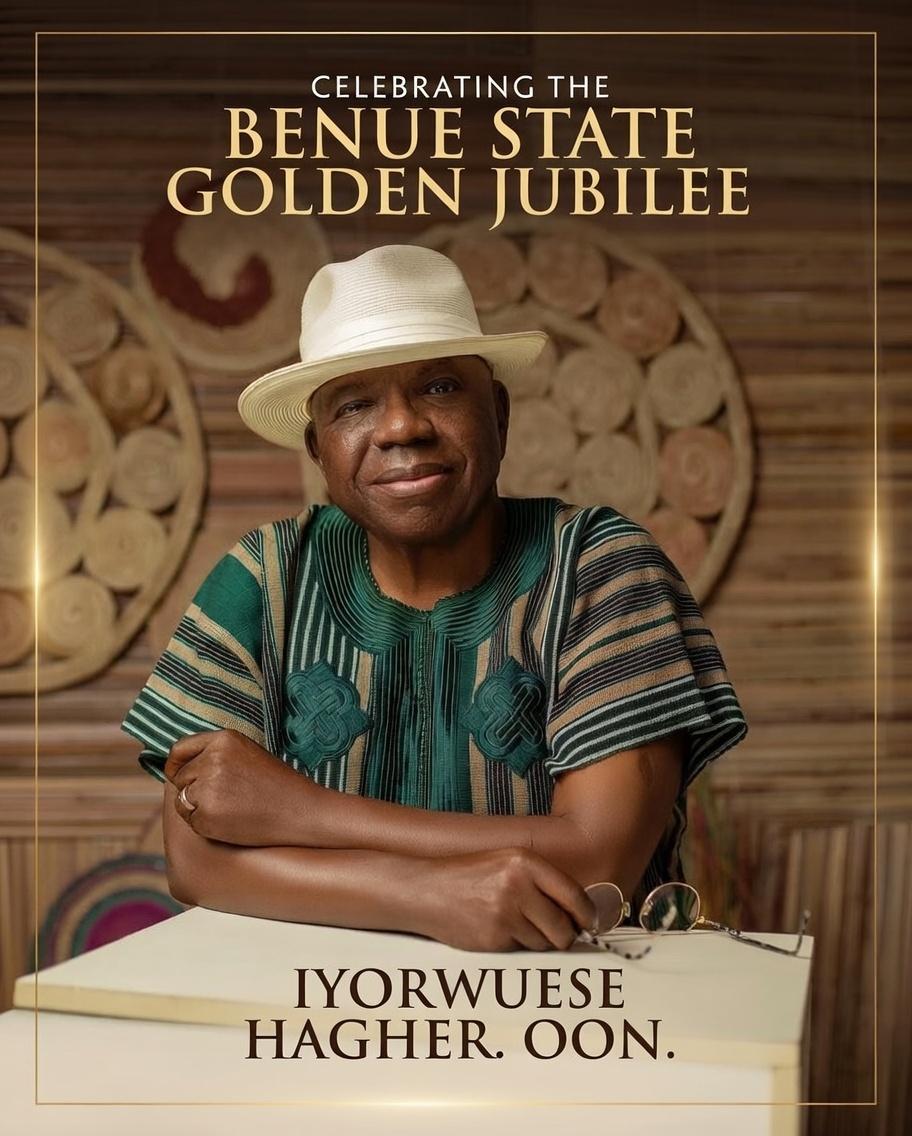
BY IYORWUESE HAGHER. OON.
I was present at the beginning.
On February 3, 1976, Benue State was created through the historic and heroic state-creation exercise carried out by the Military Administration of General Murtala Mohammed. Born alongside second-generation states such as Bauchi, Borno, Imo, Niger, Ogun, Ondo, and the FCT, Benue entered the Nigerian Federation with hope, cultural confidence, and vast agricultural promise.
Fifty years later, there is no mass celebration with jubilant dances, parties, and anthems to mark achievements or express hope, nor reflective publications, nor individuals honoured at public ceremonies for landmark achievements or contributions to the emergence of the present Benue State. We expected the BNSG to rally the whole state to Makurdi for a weeklong stocktaking of the past 50 years, to celebrate our achievements and to decry our failures. Instead, there is underwhelming silence, deliberate looking away and looking down, yet revealing the tragedy of failed dreams, thwarted visions, and cascades of leadership failures.
As one of the founders of Benue State and the founding Chairman of the Benue State Council for Arts and Culture, my task was clear: to help give a new state a new soul. We understood that development without culture is directionless and that people who forget their stories soon forget their responsibilities. The Arts Council moulded unity from the diverse ethnic tapestry: Etulo, Idoma, Igala, and Igede.
At the outset, we collectively envisioned a state with extraordinary advantages. There was fertile land, a vibrant agrarian economy, a rich intellectual tradition, and a culturally cohesive, non-Muslim, non-Hausa Fulani-conquered population. We boasted of ruling the nation through agricultural industrialisation, rural development, and educational leadership.
Over the decades, I have served Nigeria in many capacities – as a Senator, Minister, Ambassador to Mexico, Panama, Costa Rica, and Guatemala, and High Commissioner to Canada. From those vantage points, I watched Benue from afar, hoping that distance would clarify progress. It did not. I even came home to contest the Governorship. I failed. Then I saw a slow erosion of institutional memory, a persistent recycling of empty promises, and a political culture detached from the people's realities.
At 50, there is little to celebrate. The Founding Fathers have been betrayed.
Infrastructure: Major road networks remain unfinished or dilapidated, and rural communities are cut off from markets. Industrial zones announced decades ago exist only on paper.
Education: Once home to respected public and private schools, including Government College Katsina-Ala, Mt. St. Michaels Secondary School, Aliade, W.M Bristow Secondary School, Gboko, Government College Utobi, Government College Makurdi, and Mt. St. Gabriel Secondary School, Makurdi, with a strong teaching and mentoring culture, Benue has seen declining educational outcomes, inadequate guidance, and rising illiteracy.
Despite a proliferation of doctoral degrees and professors from tertiary institutions (a bragging right), Benue State's Human Development Index (HDI) remains a pitiful indicator of low literacy and school-environment rates, and even lower tertiary attainment. Benue youth are jobless, unemployed, and unemployable because they lack skills. In rural Benue communities, especially in conflict areas such as Kwande, Agatu, Apa, Gwer-West, Guma, Katsina-ala, Logo, Makurdi, and Ukum, the government seems to have abandoned governance, ceding it to herders and bandits.
Benue’s living standards metrics and Human Development Index (HDI) lag behind those of states created in 1976 and even those created twenty years later. For over twenty years, investment in people and services has been insufficient and ineffective.
In health care delivery, the state has fewer health resources per person and a weak health care system.
Benue State has the highest number of Internally Displaced Persons in Nigeria, reflecting repeated violence that disrupts livelihoods and public services. Repeated genocidal attacks from outside sources like Fulani Herdsmen and local politician-bred bandits have dis-proportionally displaced communities, damaged infrastructure and deterred investments. Insecurity has undermined all pillars of development, making the state one of the most unstable and unsafe places to live in Nigeria.
Amidst all this dystopia, the political class, especially the Benue State Government, is in denial. It refuses to engage with the pain and trauma of ordinary Benue people.
The Benue condition is a humanitarian crisis, a cesspool of persistent violence, displacement of farming communities, and prolonged insecurity. The Benue condition has eroded economic productivity and social and political trust.
I am an Internally Displaced Person, too. I come from a proud community in Kasar, Katsina-Ala. I have been displaced from Kasar, along with my kinsfolk, for over ten years. My family, like thousands of others, has fled for our lives, leaving the Fulani herdsmen and their local comprador bandits to take over our homes, farms, schools, churches, and community.
Our fate is now forgotten, and over five thousand graves in Sankera, since 2015, are merely a regretful reminder of vicious crimes against our people. Likewise, the recent genocidal attacks against our people in Kwande at Abende on the Benue-Cameroon border have not made the national headlines. The Government has turned its back on the people who elected it to power.
Our inability to host a public week-long jubilee celebration is, in itself, a silent admission and public confession that the State Government is more interested in politics, social travel, and capital flight than in governance. A celebration of our golden jubilee would have required bringing everybody together, a task the Benue State Government vehemently opposes. The posthumous award to the veteran journalist Dan Agbese, presented during a state broadcast by His Excellency, Governor Alia, is well deserved. We thank the governor, but sadly it is too late and too little: Agbese died only recently, and his corpse is yet to be interred.
BNSG is a systematic machine for the dismemberment of unity and cohesion. Bringing all of us together would have required an honest answer to the pathetic narrative of squandered goodwill and squandered opportunities, and the credibility gap between Benue's potential and its tragic reality.
Beyond the Jubilee Celebration
Now that the failed expectations of a robust jubilee celebration have risen and ebbed, the Benue people must all rise and create history together. We must end this dystopia with new leadership in Benue. We must look beyond this failed jubilee celebration, look beyond leadership failure and lack of cohesion. The real question is whether the Benue people will continue to reward poor leadership and make poor choices that fail to translate memory into progress for our people, or whether, as the new circle of political recruitment looms, character, integrity, and public spirit will be our watchword.
Iyorwuese Hagher, OON.
On behalf of:
The founders: J.S. Tarka, J.C. Obande, Aper Aku, Joseph Akperan Orshi, Isaac Shaahu, Paul Unongo, Suemo Chia, J.T. Akure, Toryima Orga, Gbihi Vembe, Acheme Paul Anyebe, Iyorwuese Hagher, Joe Omakwu, Oguji Ikongbe, Vincent Okwu, Simon Shango, Audu Ogbe, Jonah Elaigwu, Ode Obarike, Edwin Ogbu, Raymond Washima Erukaa, Mvendaga Jibo, Shima Gyoh, Chia Surma, Simon Bai, Hemen Tyungu, Yongo Humbe, Jerome Tilley Gyado, Atim Atedze, Ugba Uye, Joseph T.Orkaa, Senator Ameh Ebute, Paul Achimugu, Simeon Bai, Justin Tseayo, Francis Idachaba, Ochapa Onazi, Hindan Asa, Agan Dankaro, Abutu Obekpa Ogwuji Ikongbe, Bernard Omaye, Ahmadu Ali, Atom Kpera. Elizabeth Afadzwana Ivase, S.P.S. Gusah. Iyorgyer Katsina Alu, Ezekiel Akiga, and Obadiah Tebu.