
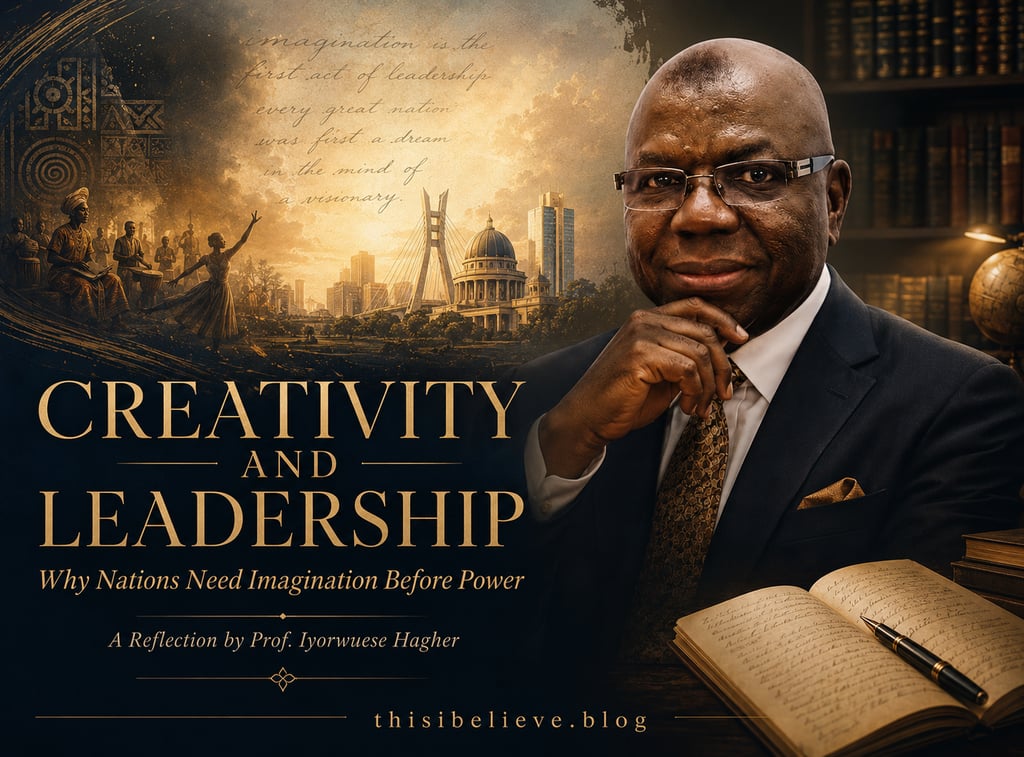
Creativity and Leadership: Why Nations Need Imagination Before Power
A reflective essay on creativity and leadership, exploring why nations, institutions, and communities need imagination, moral courage, and vision to build a better future.
CREATIVITY
Iyorwuese Hagher
5/26/20266 min read
Leadership without creativity becomes administration.
Creativity without leadership becomes private brilliance.
But when creativity and leadership meet, societies begin to move from survival to transformation.
This is one of the truths our time must recover. We often speak of leadership as though it is only about authority, office, command, protocol, and decision-making. We speak of creativity as though it belongs only to artists, writers, musicians, dramatists, designers, and inventors. But these are limited definitions. Leadership is larger than office. Creativity is larger than art.
Creativity is the ability to see possibility where others see only limitation.
Leadership is the courage to organise that possibility into action.
A nation that lacks creative leadership will continue to repeat old failures with new slogans. It will rename problems without solving them. It will recycle excuses and call them policy. It will celebrate movement without progress. It will confuse noise with vision.
This is why creativity is not a luxury in leadership. It is a necessity.
The leader who cannot imagine a better society cannot build one.
Every great transformation begins first as an act of imagination. Before a road is constructed, someone must imagine connection. Before a school is built, someone must imagine a child becoming more than his circumstances. Before a nation is reformed, someone must imagine justice stronger than greed, institutions stronger than personalities, and citizenship stronger than tribal fear.
The tragedy of many societies is not only that they lack resources. It is that they lack imagination guided by moral purpose.
Africa has never lacked intelligence. Nigeria has never lacked gifted people. In our villages, cities, schools, markets, farms, studios, churches, mosques, theatres, and digital spaces, there is extraordinary talent. There are young people creating businesses from small rooms, artists giving shape to memory, teachers holding classrooms together with sacrifice, women turning hardship into survival, and thinkers asking questions that deserve national attention.
Our problem is not the absence of creativity.
Our problem is the failure of leadership to recognise, organise, protect, and elevate creativity for the common good.
A creative nation is not built merely by having creative individuals. It is built when leadership creates systems where creativity can breathe.
This means education that encourages questioning, not only memorisation. It means public policy that rewards innovation, not only connection. It means institutions that allow young people to experiment, fail, learn, and rise. It means cultural respect for thinkers, artists, entrepreneurs, researchers, farmers, technologists, and builders.
No nation rises by suppressing the imagination of its people.
The creative mind is often misunderstood because it disturbs comfort. It asks why. It refuses to accept that yesterday’s failure must become tomorrow’s destiny. It challenges old arrangements. It sees beyond the visible. It makes those who benefit from decay uncomfortable.
This is also why leadership must have courage.
A leader without courage will fear creative people. He will prefer flatterers to thinkers. He will prefer obedience to originality. He will prefer silence to honest counsel. Such a leader may enjoy control, but he will never produce renewal.
Creative leadership does not mean recklessness. It does not mean novelty for its own sake. It does not mean abandoning wisdom, tradition, or institutional memory. True creativity respects the past but refuses to be imprisoned by it. It listens to history but does not allow history to become a prison.
The best leaders are not those who merely preserve what exists.
They are those who understand what must be preserved, what must be repaired, and what must be courageously reimagined.
This is where creativity and leadership become moral work.
For a country like Nigeria, creativity must not be reduced to entertainment alone. It must enter governance, education, agriculture, technology, security, public communication, community development, and national planning. We must ask creative questions about old problems.
How do we educate children for a future that is already arriving?
How do we create jobs in a digital economy while millions of young people remain excluded?
How do we build cities that serve human dignity rather than punish the poor?
How do we make agriculture attractive, profitable, modern, and secure?
How do we use technology without losing our humanity?
How do we govern diversity without turning difference into fear?
These are not only technical questions. They are creative leadership questions.
A leader must be able to see the human being behind the policy. He must understand that development is not only about buildings, budgets, and ceremonies. Development is about releasing human possibility.
The road matters because it connects people to opportunity.
The school matters because it enlarges the mind.
The hospital matters because life is sacred.
The theatre matters because society needs memory.
The library matters because a nation without reading becomes easy to deceive.
The digital space matters because the future now speaks through technology.
A creative leader sees these connections.
He understands that leadership is not the management of appearances but the cultivation of possibilities. He knows that the work of governance is not merely to control citizens but to help them become fuller human beings.
This is why education is central.
A society that kills curiosity in children should not be surprised when it produces adults who cannot solve problems. If we train children only to repeat what they are told, we should not expect them to build what the world has never seen. If classrooms punish imagination, the nation will eventually pay the price in weak institutions, poor innovation, and dependent thinking.
The future belongs to societies that teach their children to think.
Not merely to pass examinations.
Not merely to seek certificates.
Not merely to memorise old answers.
But to observe, question, create, build, collaborate, and serve.
Creativity must be disciplined by purpose. Leadership must be softened by humanity. When creativity lacks moral direction, it can become manipulation. When leadership lacks imagination, it becomes routine authority. But when creativity is joined with conscience, and leadership is joined with vision, societies are renewed.
This is also true in personal life.
Every person is called to lead something: a family, a classroom, a business, a community, a church, a mosque, a platform, a profession, a conversation, or even one’s own character. Leadership does not begin when people start calling your name. It begins when you accept responsibility.
And creativity does not begin when the world applauds your talent. It begins when you refuse to let limitation have the final word.
The mother who finds a way to feed her children in hardship is creative.
The teacher who turns a poor classroom into a place of hope is creative.
The young entrepreneur who builds a business from almost nothing is creative.
The writer who gives language to a people’s pain is creative.
The leader who listens, learns, and changes course before disaster arrives is creative.
Creativity is not always loud. Sometimes it is quiet problem-solving. Sometimes it is patience. Sometimes it is moral imagination. Sometimes it is the ability to see dignity where society sees only poverty.
This is why I believe that the future of leadership must be imaginative, humane, and morally serious.
We do not need leaders who simply inherit old chairs and sit on them with new confidence. We need leaders who understand that the chair is not the mission. The people are the mission. The future is the mission. Justice is the mission.
We need leaders who can think beyond election cycles.
Leaders who can build institutions rather than monuments to themselves.
Leaders who can invite talent rather than fear it.
Leaders who can turn creativity into policy, and policy into human progress.
We need a leadership culture that values writers, artists, scientists, teachers, technologists, farmers, engineers, philosophers, entrepreneurs, and community organisers as nation-builders. No society is built by politicians alone. A nation is built by the disciplined imagination of all its people.
The artist helps a nation remember.
The teacher helps a nation think.
The scientist helps a nation discover.
The entrepreneur helps a nation produce.
The farmer helps a nation live.
The writer helps a nation speak.
The leader must bring these energies together.
That is the work of creative leadership.
In the end, creativity and leadership are both acts of faith. The creative person believes that something new can be born. The true leader believes that people can be organised toward a better future. Both reject despair. Both challenge stagnation. Both require discipline, courage, and sacrifice.
Nigeria does not only need more power.
Nigeria needs more imagination in power.
Africa does not only need more speeches.
Africa needs leaders who can convert vision into institutions, talent into opportunity, and suffering into reform.
The world is changing quickly. Technology is rewriting work. Artificial intelligence is reshaping knowledge. Climate change is disturbing old patterns of life. Young people are demanding voice, meaning, and opportunity. Old methods will not answer all new questions.
This is why leadership must become creative, and creativity must become responsible.
The future will not be kind to societies that fear imagination.
It will belong to those who can dream with discipline, build with wisdom, and lead with humanity.
Leadership without creativity may preserve the office.
But creativity with leadership can rescue the nation.