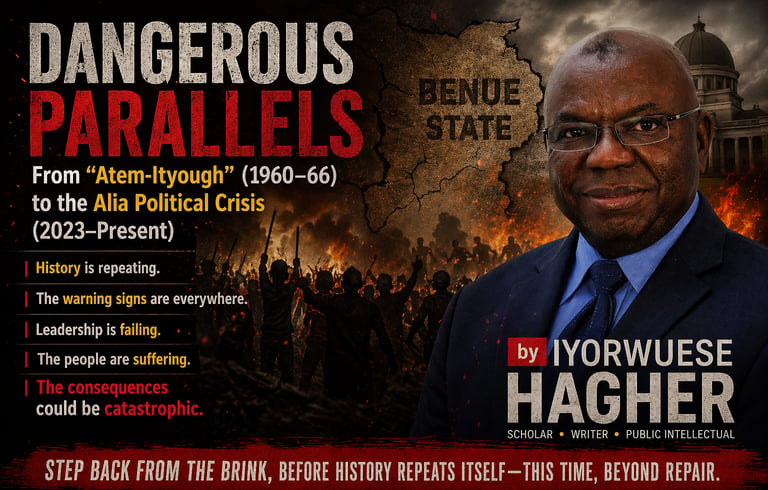
Dangerous Parallels: From “Atem-Ityough” (1960–66) to the Alia Political Crisis (2023–Present)
What happened in Tivland in the early 1960s is not buried in the past. It is re-emerging before our eyes. Its patterns are returning. Its provocations are returning. Its abuses of power are returning. Its blindness is returning.
NATIONHOODLEADERSHIPLIFE
Iyorwuese Hagher
4/14/20267 min read
Serious scholars have long agreed, and Haroun Al Rashid Adamu made it painfully clear, that the Tiv uprisings of 1960–66, alongside the post-election violence in the Western Region, were among the fatal convulsions that pushed Nigeria toward the 1966 military coup and the long, suffocating era of authoritarian rule that followed.This is not a matter of idle historical reflection. It is a matter of grave national memory.
And that is precisely why this essay must not be mistaken for nostalgia. It is a warning. A sharp, urgent, and uncompromising warning to those in power, to those intoxicated by arrogance, and to those foolish enough to think history has lost its capacity to punish political stupidity.
What happened in Tivland in the early 1960s is not buried in the past. It is re-emerging before our eyes. Its patterns are returning. Its provocations are returning. Its abuses of power are returning. Its blindness is returning. Only this time, the consequences may be far more disastrous. The crude weapons of yesterday have given way to more sophisticated instruments of destruction. What was once a regional revolt now risks maturing into a far more devastating implosion.
Benue is drifting toward dangerous ground.
And those who continue to inflame division, suppress dissent, trivialise suffering, and govern as though power were a private inheritance should not pretend innocence when the fire they have kindled begins to consume the entire house.
As Robert D. Kaplan warned in The Coming Anarchy:
> “The coming anarchy will not be marked by the collapse of states alone, but by the erosion of legitimacy, the rise of criminal politics, and the unchecked violence of groups who no longer believe in the system.”
Benue now stands perilously close to that edge.
The Seeds of Revolt: Tivland, 1960–66
History is never silent. It speaks with clarity. The tragedy is that those drunk on power rarely listen until consequences begin to speak louder than reason.
The Tiv revolts did not erupt from nowhere. They were not the actions of a lawless people acting on impulse. They were not some irrational disturbance, as dishonest interpreters later tried to suggest. They were the bitter harvest of systematic injustice, political exclusion, cultural humiliation, and organised repression.
A people who had fought hard to preserve their identity and dignity found themselves trapped inside a political arrangement designed to deny them voice, deny them fairness, and deny them belonging. The imposition of a Native Authority hostile to popular will created a dangerous break between rulers and the ruled. Leadership ceased to be a moral trust and became a weapon of domination.
Supporters of the UMBC/AG alliance were denied jobs, hounded, jailed, and persecuted. Traditional institutions were stripped of their moral dignity and turned into useful instruments of coercion. The Native Authority police did not defend justice. They defended the interests of power. They became servants of partisan oppression.
The Tiv revolted because peaceful alternatives had been blocked.
They revolted because their grievances were cultivated, not imagined.They revolted because when injustice becomes policy, resistance eventually becomes inevitable.That is the truth of history. And it is a truth that should terrify any government in Benue that is carelessly reproducing the same conditions under a different name.
Echoes in the Present: Benue Under Dangerous Strain
The political climate in Benue State today bears an alarming resemblance to that dark and combustible era.The administration of Governor Rev. Fr. Hyacinth Alia, rather than healing divisions and building broad civic confidence, has deepened fault lines, sharpened resentment, and normalised an atmosphere of exclusion and confrontation. Governance is no longer widely seen as a collective trust held in the interest of all. It is increasingly perceived as the private preserve of a narrow clique, insulated by power and indifferent to consequence. That is not statesmanship. That is the early architecture of crisis.
The warning signs are glaring.
1. Incendiary Rhetoric and the Suppression of Political Space
The restriction of political gatherings, except those aligned with the ruling circle, is not governance. It is intolerance masquerading as order. It is fear pretending to be strength. It is what happens when a government loses the confidence to persuade and begins instead to rely on control.
History is merciless on this point: when political space begins to shrink, tension begins to expand.
Words are not harmless. Language can poison the public sphere long before conflict fully emerges. Reckless rhetoric, demonisation of opponents, and the treatment of dissent as sabotage create a climate in which public anger is no longer contained by democratic channels.
That is how dangerous politics ripens.
2. Economic Exclusion and Patronage as a Weapon
Like the Native Authority arrangement of the 1960s, the present atmosphere in Benue increasingly creates the impression that public resources are being distributed not on the basis of justice, citizenship, or merit, but on the basis of submission and partisan loyalty.
Jobs, contracts, appointments, empowerment, and access are increasingly seen not as rights of belonging, but as rewards for obedience. That is not administration. That is patronage weaponised as policy.
And where exclusion becomes normal, resentment does not disappear. It ferments. It deepens. It waits.
A government that teaches its citizens that fairness has died should not be surprised when the people stop believing in the system.
3. The Politicisation of Traditional Authority
Traditional rulers are supposed to stand above the grime of partisan struggle. They are meant to embody continuity, moral restraint, and communal balance. The moment they are reduced to instruments of temporary political convenience, they begin to lose the sacred authority that gives them relevance.
A traditional institution that becomes a mouthpiece for power ceases to be a refuge for the people.
That loss is dangerous. Because once the people begin to see traditional rulers not as custodians of culture and conscience, but as agents of political intimidation, an essential moral bond is broken. And once moral bonds break, social order begins to decay from within.
4. Perception of External Alignment and Internal Betrayal
Politics does not operate only through facts. It operates through symbols, perceptions, and meaning. In moments of instability, symbolism can wound more deeply than policy. Visible gestures and alignments that appear to place external loyalties above local pain are politically toxic. Whether intended or not, they are often interpreted as signs of detachment, surrender, or betrayal. A people already under pressure do not ignore such signals. They absorb them, and they react to them.
Leaders who underestimate the power of perception are often the same leaders shocked by the anger they helped produce.
5. Denial of Violence and the Betrayal of Public Suffering
Nothing destroys moral legitimacy faster than indifference to the pain of the people.
Benue is bleeding. Communities are under siege. Families are displaced. Citizens live under fear and uncertainty. Yet the minimisation, evasion, or denial of this suffering is not merely politically irresponsible. It is morally scandalous.
A government that cannot speak honestly about the anguish of its people has already begun to lose the right to speak for them. And once citizens feel abandoned, unheard, and unprotected, they begin to search for alternatives outside the state. That is when self-help takes root. That is when lawful order weakens. That is when chaos begins to gather legitimacy in the eyes of the abandoned.
6. Urban Spectacle and Rural Abandonment
Visible projects in Makurdi cannot hide the deeper shame of neglect in the rural communities. Excavations, roadworks, and urban display mean very little to citizens whose villages remain exposed, their livelihoods shattered, and their existence treated as an afterthought. Development that excludes the majority is not development. It is political theatre.
A government that beautifies a few visible centres while large swathes of the state live in fear is not governing with vision. It is merely decorating failure. And cosmetic governance, however loudly advertised, cannot substitute for justice, security, and shared dignity.
7. Economic Drain, Dubious Priorities, and Public Distrust
Allegations of inflated contracts, misplaced priorities, and external profiteering deepen the public suspicion that the state is being hollowed out by those who should be defending it.
Once the people begin to believe that their hardship is underwriting the comfort of a privileged few, trust begins to die. And once trust dies, everything government says begins to sound false, every project becomes suspect, and every policy is judged through the lens of betrayal.
That is how legitimacy collapses: not only through force, but through greed.
8. The Dangerous Language of Absolutism
The slogan, “No Alia, No Benue,” is not harmless enthusiasm. It is dangerous political poison.
It is the language of absolutism. It is the language of idolatry. It is the language of democratic decay.
No man is Benue. No governor is Benue. No temporary occupant of office, however celebrated by praise-singers, can be equated with the destiny of an entire state.
Benue existed before Alia. Benue will exist after Alia. Any politics that reduces a people, their history, their suffering, and their future to one personality is not loyalty. It is political fanaticism. And fanaticism is the enemy of peace. The moment dissent is treated as treason, conflict is already incubating.
A Personal Witness and a Public Warning
I do not write as a detached observer. I write as one who has seen this darkness before.
As a child in Ukum and Gboko, I witnessed the turbulence of the Tiv revolts firsthand. I saw communities shaken. I saw the consequences of repression. I saw how quickly public order collapses when leadership loses moral legitimacy and still insists on ruling by force of ego and arrogance.
My father, a school headmaster and church planter, was imprisoned because he refused to bow to oppression. That memory is not an abstract historical reference to me. It is personal. It is living. It remains a permanent reminder of what happens when power becomes deaf to conscience.
That is why I refuse to watch the present warning signs in silence.
What I see in Benue today is not ordinary political disagreement. It is a dangerous degeneration of political culture, a reckless hardening of exclusion, and a steady manufacture of the very conditions that history has already shown can produce disaster.
Conclusion:
Benue Is Standing Too Close to the Edge, Benue State today stands too close to the edge.
History has already passed judgment on societies that choose exclusion over inclusion, propaganda over dialogue, intimidation over persuasion, and power over service. Such societies do not remain stable. They decay. They fracture. They move steadily toward breakdown.
This is not prophecy. This is not exaggeration. This is not partisan bitterness. It is pattern recognition.
I have spent decades in public life. I have seen arrogance in office. I have seen nations wounded by leaders too proud to listen and too sheltered to care. But I say this with all the force conscience can summon: the present political atmosphere in Benue is saturated with the ingredients of avoidable disaster.
Those who dismiss these warning signs today may tomorrow pretend that nobody warned them.
Let no one say they were not told.
This is not an attack for the sake of attack. It is a final moral appeal before the damage becomes irretrievable.A call to the Governor. A call to his advisers. A call to political actors. A call to traditional rulers. A call to the people.
Step back from this path. Abandon the arrogance of exclusion. Stop weaponising power. Stop insulting the pain of the people. Stop confusing propaganda with leadership. Restore dialogue. Restore justice. Restore restraint.
Because once a society begins its descent into anarchy, it does not pause to ask who lit the first match before it consumes everyone.
And as Kaplan warned, when legitimacy dies, violence takes its place. May wisdom prevail before Benue is dragged into a tragedy from which recovery may come too late.
Iyorwuese Hagher