
Ethnicity, Power, and the Crisis of Belonging
We speak of unity, but many citizens do not feel equally owned by the country. We sing the anthem, but the melody often struggles against the realities of suspicion, exclusion, and injustice. We proclaim one nation under God, but in daily life many Nigerians are first interrogated by their ethnicity, religion, region, language, and state of origin before they are accepted as citizens.
LIFELEADERSHIPNATIONHOOD
Iyorwuese Hagher
5/19/20267 min read
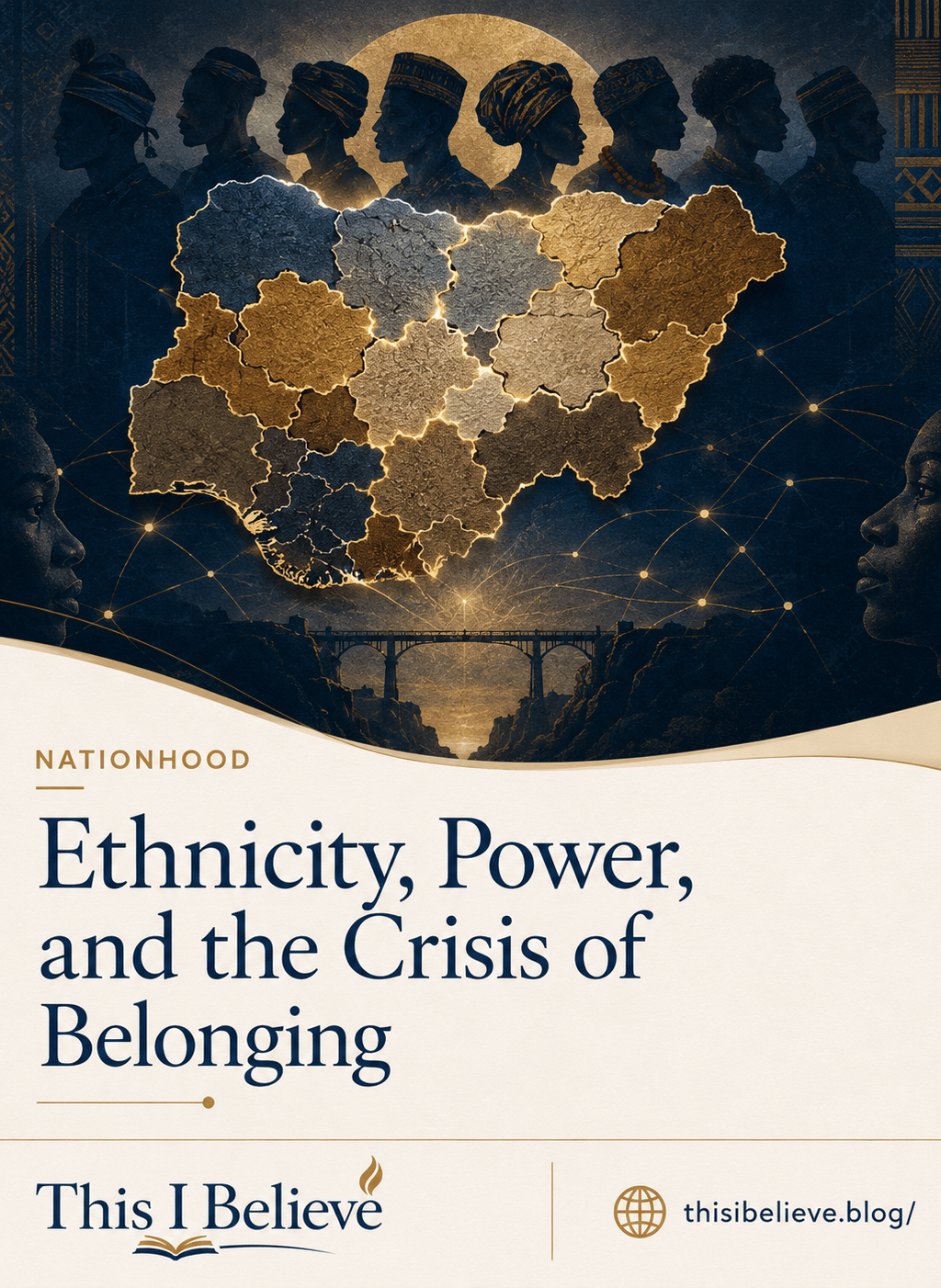
There is a wound in the Nigerian nation that we have too often covered with slogans. It is the wound of belonging.
We speak of unity, but many citizens do not feel equally owned by the country. We sing the anthem, but the melody often struggles against the realities of suspicion, exclusion, and injustice. We proclaim one nation under God, but in daily life many Nigerians are first interrogated by their ethnicity, religion, region, language, and state of origin before they are accepted as citizens.
This is the crisis of belonging.
It is not a small matter. A nation is not built only by boundaries, flags, constitutions, elections, and offices. A nation is built by the emotional conviction of its people that they have a place in it. When citizens believe that the nation sees them, protects them, respects them, and gives them fair opportunity, belonging becomes natural. But when citizens feel permanently excluded, mocked, suspected, or treated as strangers in their own country, the soul of the nation begins to weaken.
Nigeria has not yet fully solved this problem.
Ethnicity, in itself, is not evil. There is nothing wrong with belonging to a people, speaking a language, preserving ancestral memory, honoring cultural identity, and drawing strength from community. Ethnicity becomes dangerous only when it is weaponized for power, privilege, exclusion, and fear. It becomes poisonous when leaders use it to divide citizens, when communities use it to deny justice, and when political actors use it as a ladder to climb into office while leaving the people poorer, angrier, and more suspicious.
The tragedy of Nigeria is not that we are many. The tragedy is that we have not learned how to be many with justice.
Our diversity should have been a source of national imagination. It should have enriched our democracy, expanded our cultural confidence, and deepened our sense of shared destiny. Instead, ethnicity has often been converted into a political instrument. It is summoned during elections, manipulated during appointments, inflamed during crises, and abandoned after power has been captured.
The people are told to defend their ethnic interest, but after victory, the same people return to hunger, insecurity, unemployment, bad roads, weak schools, and abandoned hospitals. The ordinary citizen who was mobilized in the name of tribe soon discovers that poverty has no ethnic mercy. Hunger does not ask for state of origin. Disease does not respect language. Banditry does not spare a man because he speaks the same tongue as a governor. Bad leadership is an equal-opportunity destroyer.
Yet the politics of ethnicity remains powerful because it feeds on fear.
Every group carries historical memories. Some remember domination. Some remember marginalization. Some remember betrayal. Some remember violence. Some remember being mocked, displaced, excluded, or politically ignored. These memories are not imaginary. Many of them are real. But if memory is not guided by wisdom, it becomes a prison. It teaches each group to see the other not as fellow citizens, but as permanent threats.
This is how nations become emotionally divided.
Power then enters the matter and makes it worse. In Nigeria, power is not merely administrative. It is often seen as protection. Communities believe that without someone from their group in office, they are unsafe, unseen, or cheated. This perception did not arise from nowhere. It arose because the state has often behaved unfairly. When public appointments, development projects, security responses, scholarships, contracts, and infrastructure are distributed with visible bias, citizens naturally retreat into ethnic shelters.
Where justice is weak, ethnicity becomes refuge.
This is why the crisis of belonging cannot be solved by merely preaching unity. Unity without justice is only a slogan. Patriotism cannot be forced upon people who feel abandoned. Citizenship cannot be meaningful where people are treated as outsiders in places where they have lived for decades. National loyalty cannot grow where fairness is absent.
Nigeria must move beyond the shallow language of “one Nigeria” and begin to build the moral conditions that make oneness believable.
A nation must ask itself difficult questions. Does every Nigerian feel safe in every part of Nigeria? Does every child believe that his or her future is not limited by tribe, religion, or state of origin? Do public institutions treat citizens as citizens, or as representatives of ethnic categories? Do leaders speak to the whole nation, or only to their political base? Do we condemn injustice only when our own people suffer it, or do we have the moral courage to defend others?
The answer to these questions will determine the future of our nationhood.
Belonging is not created by propaganda. It is created by experience. A citizen belongs when he can live, work, study, worship, trade, marry, vote, and contribute without being perpetually treated as a stranger. A citizen belongs when the law protects him equally. A citizen belongs when his dignity does not depend on the ethnic identity of the person in power.
This is one of the failures of our national imagination. We have not yet fully created a citizenship stronger than origin. We still ask, “Where are you from?” more urgently than, “What can you contribute?” We still use ancestry as a gatekeeping mechanism. We still confuse indigeneity with ownership of the republic. We still build walls inside a country that desperately needs bridges.
The state-of-origin culture has deepened this problem. It has produced a cruel contradiction: a Nigerian may be born in a state, grow up there, pay taxes there, raise children there, contribute to its economy, and still be treated as a non-indigene. Such a person is Nigerian in theory but homeless in practice. This is not merely administrative inconvenience; it is a moral injury.
No nation can achieve greatness when millions of citizens carry uncertain belonging.
The crisis becomes even more dangerous when elites manipulate ethnic identity to escape accountability. A corrupt leader accused of theft suddenly becomes a victim of ethnic persecution. An incompetent official dismissed from office suddenly claims that his people are under attack. A politician seeking relevance inflames old grievances. A failed government hides behind ethnic sentiment. In such moments, ethnicity becomes a shield for wrongdoing.
This is why citizens must become wiser.
We must learn to distinguish between genuine group injustice and elite manipulation. There are real cases of marginalization that must be confronted honestly. But there are also cases where selfish leaders hide their failures behind ethnic emotion. The people must not allow themselves to be used as foot soldiers in battles that do not improve their lives.
The poor man from one ethnic group has more in common with the poor man from another ethnic group than he often realizes. Their children attend struggling schools. Their wives face weak healthcare systems. Their roads are broken. Their farms are unsafe. Their young people are unemployed. Their dreams are delayed by the same corrupt political order. But instead of uniting around justice, they are often divided by identity.
This division benefits those who profit from national confusion.
The answer is not to erase ethnicity. That is impossible and undesirable. A healthy nation does not destroy cultural identity; it harmonizes it within a just political order. Nigeria should not ask citizens to stop being Tiv, Yoruba, Igbo, Hausa, Idoma, Fulani, Ijaw, Kanuri, Nupe, Ibibio, Efik, Gbagyi, Jukun, Berom, Urhobo, or any other identity. It should ask them to become fully themselves while also becoming fully Nigerian.
This is the great task of nationhood: to create a political home large enough for all identities, but just enough to prevent any identity from becoming a weapon against another.
Leadership has a central role in this work. A leader must not speak like an ethnic champion when the office he occupies belongs to all. He may come from a place, but once entrusted with authority, he must serve beyond that place. The moral test of leadership is not how loudly a leader defends his own people, but how fairly he treats those who did not vote for him, those who do not resemble him, and those who have no access to his inner circle.
Power must be disciplined by justice.
When leaders distribute opportunity fairly, citizens relax their fears. When institutions work impartially, ethnic suspicion loses strength. When the police protect everyone, when courts judge without bias, when appointments reflect merit and inclusion, when development reaches forgotten communities, the nation begins to heal.
But where power behaves like ethnic property, belonging collapses.
Nigeria must therefore rebuild citizenship as the highest political identity. This does not mean cultural identities should disappear. It means citizenship must guarantee dignity, rights, protection, and opportunity beyond origin. A Nigerian should not become less Nigerian because he travels to another part of Nigeria. A child should not inherit exclusion because her parents migrated. A worker should not be denied public opportunity because his surname sounds unfamiliar.
If Nigeria is truly one country, then citizenship must have practical meaning.
The crisis of belonging also demands a new moral education. Families, schools, religious institutions, media, artists, writers, traditional rulers, and public intellectuals must help Nigerians imagine one another more generously. We must teach history honestly, but not hatefully. We must remember wounds, but not use memory to manufacture permanent enemies. We must expose injustice, but not turn grievance into identity.
A nation heals when truth and compassion meet.
The Nigerian imagination must become larger than fear. We must begin to see our diversity not as a curse, but as a difficult gift. Difficult, because it requires patience, fairness, negotiation, and humility. A gift, because it gives us cultural wealth, human depth, and historical richness that few nations possess.
But diversity without justice becomes disorder.
That is the warning before us.
Ethnicity will remain part of our national life. The question is whether it will serve memory or hatred, culture or exclusion, identity or violence, belonging or division. Power will also remain contested. The question is whether power will be pursued as service or captured as ethnic entitlement.
Nigeria stands at the intersection of these choices.
We can continue to build a country where citizens retreat into ethnic fear, where every election becomes a tribal census, where every appointment becomes a battlefield, and where every grievance becomes a threat to national cohesion.
Or we can build a country where justice gives citizens the courage to belong.
This is not naïve optimism. It is a national necessity.
For a nation does not endure merely because people are forced to remain together. A nation endures when people, despite their differences, find enough fairness, dignity, and hope to continue believing in a shared future.
That is the work before Nigeria.
Ethnicity must not be allowed to murder citizenship. Power must not be allowed to destroy justice. And no Nigerian should be made to feel like a stranger in the house he is called to defend.
Belonging is not a gift from the powerful to the weak.
It is the birthright of every citizen.
And until Nigeria makes this truth real, the crisis of belonging will remain one of the deepest wounds in our nationhood.