
Federalism and the Nigerian Imagination
Blog post description.
NATIONHOODLEADERSHIP
Iyorwuese Hagher
5/15/20266 min read
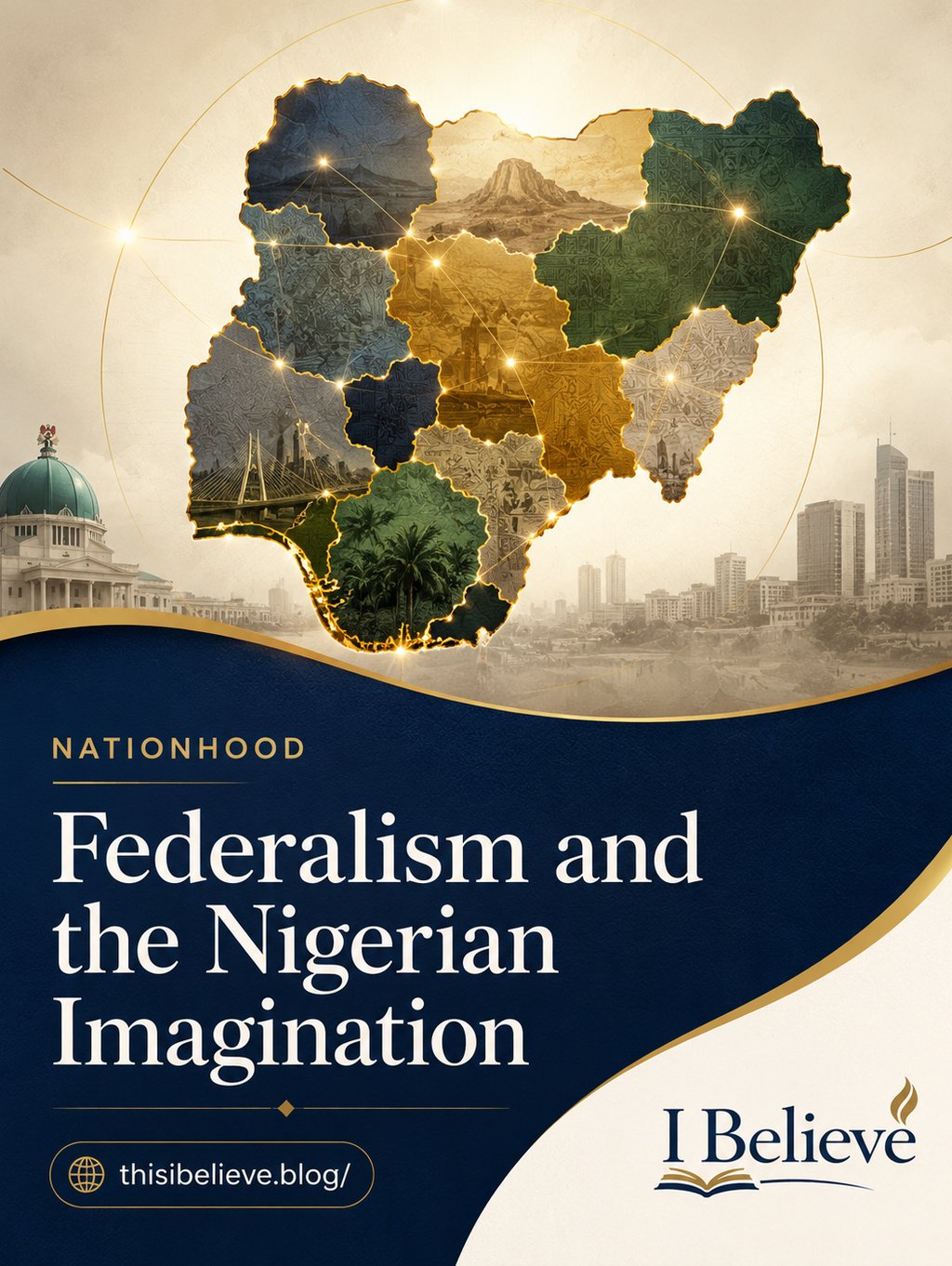
Few words in the Nigerian political vocabulary are as frequently invoked, and as poorly understood, as federalism.
It is a word that appears in speeches, constitutional debates, newspaper columns, academic conferences, and political promises. It is often used with conviction, but not always with clarity. For some, federalism is the answer to Nigeria’s political instability. For others, it is a slogan employed whenever dissatisfaction with the center becomes unbearable. For many citizens, it remains an abstract constitutional concept—important, perhaps, but distant from the daily realities of hunger, insecurity, unemployment, and injustice.
Yet federalism is not a decorative political theory. It is one of the central questions of the Nigerian imagination. It forces us to ask: What kind of country do we believe Nigeria is? What kind of union do we want? How should power be shared in a nation of many peoples, many histories, many fears, and many aspirations?
These are not small questions. They go to the soul of the republic.
Nigeria is not merely a geographical expression. It is a complicated historical inheritance. It is a state formed by colonial arrangement, sustained by political struggle, wounded by mistrust, but still alive with possibility. Its diversity is both its burden and its promise. Hundreds of ethnic nationalities, multiple languages, several religious traditions, different historical experiences, and unequal developmental trajectories coexist within one political house. The challenge has never been whether Nigeria is diverse. The challenge has always been whether its political structure truly respects that diversity while preserving national unity.
This is where federalism becomes indispensable.
At its simplest, federalism is an arrangement in which power is shared between a central authority and constituent units in such a way that neither level of government is entirely subordinate in its proper sphere. In theory, it is meant to balance unity with autonomy. It is meant to create a political order where people can belong to a larger nation without losing the dignity of their local identities and interests.
But in Nigeria, the problem is that we often proclaim federalism while practicing something closer to central domination.
Too much power sits at the center. Too many decisions that should reflect local realities are determined by distant authority. Too much revenue control is concentrated in Abuja. Too many states function like administrative dependents, waiting monthly for allocation, unable to generate enough internal strength, imagination, or fiscal independence. In such a condition, what we call federalism becomes a tired performance. The structure exists in name, but not always in spirit.
A genuine federation cannot thrive where the center behaves like a landlord and the federating units like anxious tenants.
This distortion has damaged the Nigerian imagination. It has weakened initiative at the subnational level. It has encouraged a political culture in which the struggle for access to the center becomes more important than the development of the states. It has made federal power appear like the ultimate prize in a winner-takes-all contest. And when control of the center becomes everything, politics becomes more desperate, more bitter, and more dangerous.
That is part of our national tragedy.
Federalism, properly understood, should reduce the fear that one group’s access to central power means another group’s permanent exclusion. It should create enough political space for every region, every state, and every community to pursue development according to its peculiar needs while remaining committed to the larger Nigerian project. It should encourage responsibility, innovation, and competitive progress among the constituent units. It should make governance more responsive because power is closer to the people.
Instead, we have often built a culture of dependency.
Many of our states are not yet politically imagined as engines of productivity, creativity, and self-directed development. They are imagined as channels for distributing federal resources. This weakens leadership. It weakens accountability. It weakens the moral seriousness of public office. A governor who governs without a strong productive base beneath him is often tempted to govern through appearance rather than transformation. And a state that depends almost entirely on the center gradually loses the psychological muscle required for real autonomy.
A federation of dependents is a contradiction.
This is why discussions of restructuring, devolution of powers, state policing, resource control, fiscal federalism, and constitutional reform continue to return with such force. They are not merely elite obsessions. They are symptoms of a deeper national unease. Nigerians know, even if not always in technical language, that something in the architecture of the union requires repair.
The question, however, is not simply whether we need federalism. The deeper question is whether we possess the political imagination to practice it honestly.
For federalism is not magic. It is not a constitutional trick that automatically produces justice. It requires trust, discipline, leadership, and a mature national ethic. It requires people who understand that decentralization is not a license for local tyranny. If power is moved from the center to the states, but the states themselves remain unjust, corrupt, unaccountable, and ethnically intolerant, then we have only relocated oppression. Bad governance at the center does not become good governance merely because it is provincial.
Therefore, the federal question is also a moral question.
What kind of leaders do we produce at the federal, state, and local levels? What kind of political culture do we reward? Do we seek office in order to serve, or merely to control resources? Do we truly believe in justice for all Nigerians, or only justice for those who resemble us? Are we willing to build institutions stronger than personalities? Can we imagine a Nigeria in which diversity is not treated as a threat, but as a source of democratic richness?
This is where the Nigerian imagination often falters.
Too often, we imagine the nation through suspicion. Each group fears domination by another. Each region remembers injury. Every constitutional conversation is haunted by the ghosts of history—civil war, military rule, marginalization, violent conflict, broken promises, and inequitable distribution. These fears are not imaginary. They arise from real experiences. But a nation cannot be built permanently on fear. At some point, memory must become wisdom, not paralysis.
The task of nationhood is to imagine a common future without denying historical wounds.
Federalism can help us do that—if we understand it not merely as a technical arrangement, but as a philosophy of coexistence. At its best, federalism says: we are many, but we can still be one; we are different, but we need not be enemies; we can share sovereignty in a manner that protects both local dignity and national stability.
That vision matters greatly for Nigeria.
A country as vast and plural as ours requires a constitutional spirit that is elastic enough to accommodate diversity without collapsing into fragmentation. It requires a center strong enough to preserve national integrity, but not so overbearing that it suffocates local initiative. It requires states strong enough to develop their people, but not so self-absorbed that they forget the national bond. It requires citizenship that is meaningful beyond state of origin, tribe, or religion.
In truth, the Nigerian imagination must move beyond the old habit of thinking that unity means uniformity.
Unity does not mean that every answer must come from the same place. It does not mean that local peculiarities must be erased. It does not mean reducing a complex nation into administrative obedience. True unity is deeper than control. It is the ability of a people to stay together because they believe fairness is possible within the union.
And fairness must be visible.
When citizens feel excluded, they begin to withdraw emotionally from the nation. When communities believe the federation does not protect them, separatist sentiment gains emotional power. When injustice becomes systemic, the language of nationhood begins to sound empty. This is why federalism cannot be discussed apart from equity, representation, and justice. Structure matters, but spirit matters too. A good constitution in the hands of bad faith can still produce bad outcomes.
Nigeria needs both structural reform and moral renewal.
We need to rethink how power is distributed. We need to revisit the exclusive and concurrent legislative lists. We need more serious conversation about fiscal responsibility and resource control. We need local governments that are genuinely functional, not merely manipulated appendages. We need security arrangements that recognize local realities while preserving national cohesion. We need a political culture that sees development not as a favor from the center, but as the duty of every level of government.
But beyond all these reforms, Nigeria needs imagination.
The imagination to see that federalism is not disloyalty to the nation.
The imagination to understand that decentralization is not disintegration.
The imagination to believe that empowering states can strengthen, not weaken, the republic.
The imagination to create a system in which no part of Nigeria feels permanently trapped, voiceless, or disposable.
This is the work before us.
Nationhood is not sustained by anthem and flag alone. It is sustained by justice, balance, dignity, participation, and trust. A nation survives when its people believe they have a future in it. And people believe in a future when the political arrangement under which they live appears fair enough to deserve their loyalty.
That is the federal challenge before Nigeria.
We must stop treating federalism as a rhetorical ornament and begin to approach it as a serious national assignment. We must ask difficult questions without fear. We must resist both the laziness of sentimentality and the recklessness of fragmentation. We must build a country that does not deny its plurality, but organizes it wisely.
For in the end, the Nigerian imagination will determine whether Nigeria remains merely a negotiated space—or becomes a truly shared nation.
Federalism, rightly pursued, may help us move from coexistence by necessity to coexistence by conviction.
And that, perhaps, is one of the most urgent tasks of our nationhood.