June 12: The Unfinished Covenant of a Wounded Republic
A reflective Democracy Day essay on June 12, Nigeria’s democratic struggle, insecurity in the Middle Belt and Benue, IDP camps, youth anger, national healing, accountability, and the unfinished Nigerian project.
NATIONHOODLEADERSHIP
Professor Iyorwuese Hagher
6/12/20266 min read
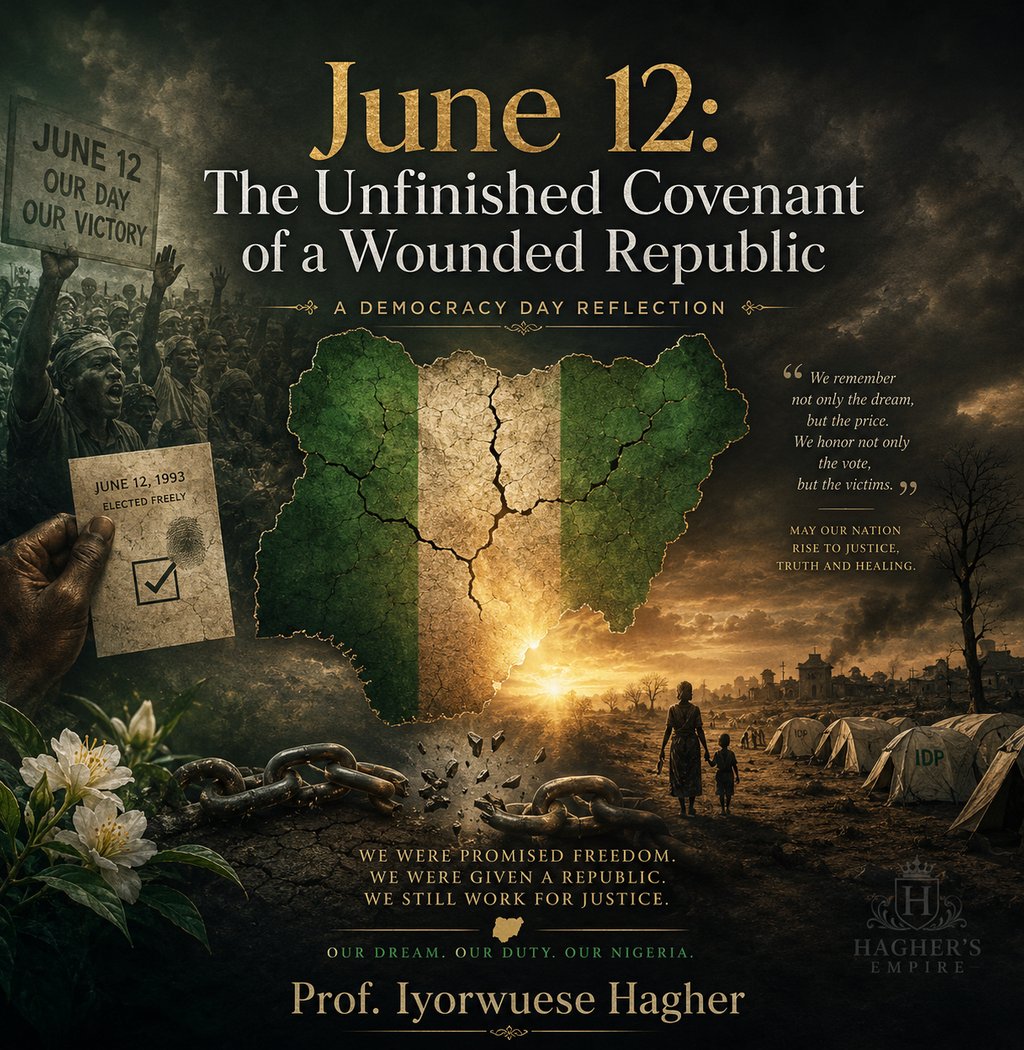
Fellow citizens of Nigeria, on this June 12, I greet you not with the careless laughter of ceremony, but with the trembling respect one brings before a shrine where both hope and betrayal are buried. There are days in the life of a nation that refuse to become ordinary dates. They rise above the calendar. They become mirrors. They become witnesses. They become wounds that will not close because the body politic has refused the discipline of healing.
June 12 is one of such days.
It stands before us like a great iroko tree struck by lightning: still standing, still sacred, yet scarred from root to crown. It reminds us that democracy in Nigeria was not handed to us as a decorative gift wrapped in constitutional paper. It was wrestled from fear. It was watered by blood. It was defended by widows, students, workers, journalists, market women, trade unionists, intellectuals, activists, and nameless patriots whose bones now sleep quietly beneath the restless soil of our Republic.
But what shall we say of a promise that has become a wound? What shall we say of a covenant whose bread has turned bitter in the mouths of the poor? What shall we say when Democracy Day arrives with speeches in Abuja, but the ordinary Nigerian wakes to the hard arithmetic of survival: the cost of food, the humiliation of unpaid labour, the silence of empty pockets, the fear of roads, the collapse of schools, the anxiety of hospitals, and the daily uncertainty of whether tomorrow will be kinder than today?
For too many Nigerians, democracy has become a flag above their heads and hunger beneath their roofs. It has become an anthem sung over empty stomachs. It has become a beautiful word that has not yet entered the kitchen, the classroom, the farm, the clinic, or the marketplace. June 12, therefore, is not merely a national holiday. It is an unfinished argument between the Nigerian state and the Nigerian soul.
I speak today as a Nigerian, but also as a son of the Middle Belt, as a son of Benue, and as an old witness to the sorrows of a land that was created to feed a nation but is now forced to bury its farmers. Across our villages, the ancestral rhythm has been broken. The hoe has fallen silent. The yam barn stands like a memory. The evening smoke from village kitchens no longer rises with the same innocence. Farmlands that once carried the laughter of planting seasons now carry the footprints of fear.
The farmer, who should be the priest of national survival, has become a refugee in his own country. The woman who once measured the year by harvest now measures it by escape. The child who should inherit ancestral soil now inherits displacement. When Benue bleeds, Nigeria’s food basket is not merely wounded; the table of the Republic is shaken.
This is why discussions about insecurity in Nigeria must not be reduced to statistics, partisan slogans, or the cold vocabulary of official briefings. We must refuse any language that turns human agony into administrative abstraction. Behind every figure is a name. Behind every name is a mother who waited by the doorway. Behind every destroyed village is a shrine of memory, a grave, a farm, a school path, a stream, a market square, and a history older than the officials who casually discuss it.
There is a geography of grief in this country, and the Middle Belt has become one of its most abandoned maps. Regions that should be feeding the nation are burying their dead. Communities that should be producing crops are producing widows. Villages that should be celebrating harvest festivals are counting the missing. A nation that neglects the regions that feed it is not merely unjust; it is suicidal.
My heart goes especially to the women and children in our internally displaced persons camps. I have lived long enough to know that the deepest wounds of a nation are often carried by those who speak the least. In those camps, women rise with the dust. They cook hope in empty pots. They cradle children beneath tarpaulin roofs and teach them patience before they have learned joy. A generation is growing behind temporary walls, learning the alphabet of displacement before the alphabet of citizenship.
These women and children are not objects of pity. They are the primary stakeholders of Nigeria’s moral debt. They are the creditors of our national conscience. We owe them more than relief materials delivered for cameras. We owe them justice. We owe them return. We owe them security. We owe them dignity. We owe them the restoration of their full humanity.
No democracy can claim maturity while its citizens live permanently as strangers within their own country. No government can speak proudly of development while children are born, raised, and educated in the psychology of displacement. No nation can call itself great when its mothers beg for safety on the same soil where their ancestors are buried.
And to the youth of Nigeria, I will not insult you by asking you to calm down as though your anger is a disease. Your rage is not madness. It is the fever of a national body fighting infection. You are angry because you can see the waste. You are angry because you were promised tomorrow and handed ruins. You are angry because talent is everywhere and opportunity is treated like a private inheritance. You are angry because your country asks you for patience while rewarding those who destroyed your future.
But rage alone, my children, is fire without architecture. It can burn the palace, but it cannot build a republic. It can shake the gates, but it cannot design institutions. It can expose hypocrisy, but it cannot replace constitutional decay with justice unless it becomes disciplined, organized, and purposeful. The urgent task before Nigerian youth is to turn anger into structure, protest into policy, noise into organization, digital fire into civic institutions, and impatience into disciplined national reconstruction.
Nigeria does not need the cheap unity of speeches. We have had too many banquets of empty words. We have heard too many seasonal sermons about peace from those who profit from injustice. True national healing is not a photograph of smiling politicians dressed in white robes. It is not a handshake across ethnic lines performed for television. It is not the lazy command that wounded people should simply move on.
National healing in Nigeria must be structural, truthful, and courageous. Healing demands accountability. Healing demands that we name the systems that have made some citizens feel superior and others disposable. Healing demands that we dismantle institutionalized bigotry, selective justice, ethnic arrogance, religious manipulation, and the politics of exclusion. Healing demands that the Constitution must no longer be a distant document written above the heads of the people, but a living covenant that gives equal worth to the child in Makurdi, the child in Maiduguri, the child in Yenagoa, the child in Sokoto, the child in Aba, the child in Ibadan, and the child in Lagos.
We cannot continue to build a nation on selective grief. We cannot mourn some dead loudly and bury others in silence. We cannot preach peace to the wounded while refusing to remove the knife. We cannot demand patriotism from citizens whose dignity has been abandoned by the state. Democracy without justice is decoration. Elections without accountability are theatre. Power without compassion is organized emptiness.
If June 12 must mean anything, it must mean that the Nigerian citizen is greater than the officeholder. It must mean that truth is stronger than propaganda. It must mean that public office is a trust, not a throne. It must mean that the vote is sacred, the citizen is sovereign, and no government has the moral right to demand loyalty from people it has refused to protect.
Still, I do not surrender Nigeria to despair. Despair is too easy. Cynicism is too cheap. I have lived long enough to know that nations, like human beings, can rise from the dust if they are brave enough to confront their sickness. The Nigerian project remains possible, but possibility is not prophecy unless citizens turn it into duty.
Let the leader govern with fear of history. Let the youth organize with discipline. Let the elder speak truth without cowardice. Let the citizen refuse the seduction of ethnic hatred. Let the Church and the Mosque remember that God is not honoured by silence in the face of injustice. Let the journalist refuse the comfort of propaganda. Let the intellectual refuse the temptation of neutrality when the nation is bleeding.
On this June 12 Democracy Day, may we hear again the footsteps of those who paid for this democracy before we inherited it. May their unfinished dream disturb our comfort. May the tears of the displaced become the ink with which we rewrite our national conscience. May the grief of Benue, the Middle Belt, and every wounded community in Nigeria become not a footnote in our history, but a summons to rebuild the Republic.
Nigeria must not become the graveyard of its own promise. It must become the difficult miracle we were born to build together.
This I Believe.
Prof. Iyorwuese Hagher
#DemocracyDay #Nigeria #MiddleBelt #BenueState #NationalHealing #June12