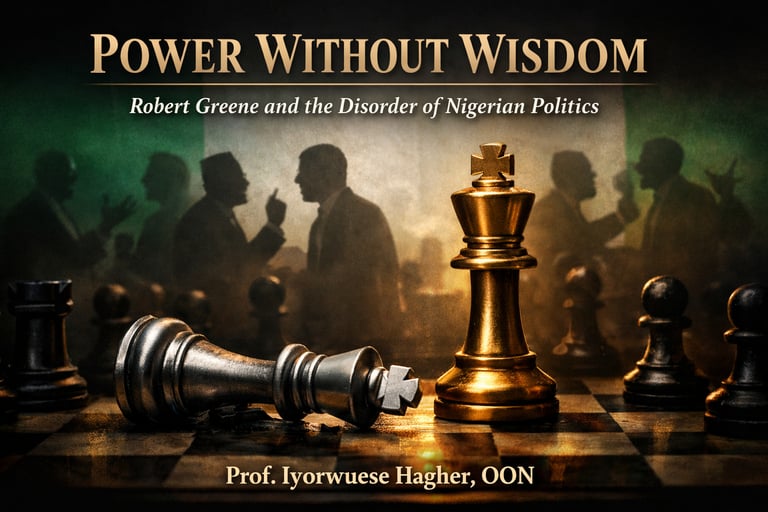
Power Without Wisdom: Robert Greene and the Disorder of Nigerian Politics
The American writer Robert Greene’s book The 48 Laws of Power has quietly become one of the most influential texts among Nigeria’s political class—despite their general suspicion of intellectual ideas and their discomfort with independent thinkers.
LIFELEADERSHIP
By Prof. Iyorwuese Hagher, OON
3/9/20263 min read
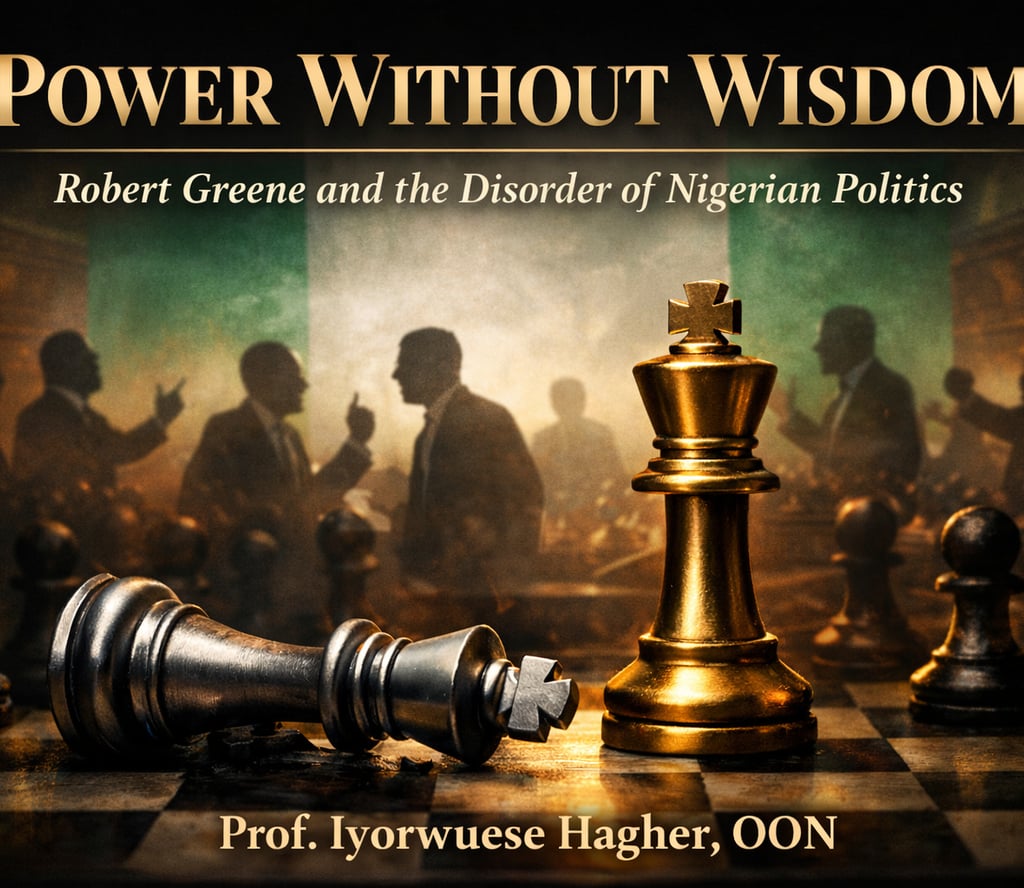
The American writer Robert Greene’s book The 48 Laws of Power has quietly become one of the most influential texts among Nigeria’s political class—despite their general suspicion of intellectual ideas and their discomfort with independent thinkers.
An examination of Nigeria’s Fourth Republic (1999–2026) reveals a recurring political pattern: the rebellion of beneficiaries of power—the godsons—against the godfathers who elevated them.
Influential politicians invest their political capital, resources, and networks to install modest, loyal candidates as governors. Yet, once in office, many of these protégés dismantle the very political structures that produced them.
This cycle has destabilised states, fractured parties, and weakened governance. In such environments, politics becomes an endless struggle for dominance rather than a platform for development.
One intellectual influence repeats throughout these conflicts: Robert Greene’s The 48 Laws of Power. For many political actors, it has effectively replaced the ethical guidance once derived from the Bible or the Qur’an.
Greene’s book distils lessons from Sun Tzu’s Art of War and Machiavelli’s The Prince, arguing that power is best acquired and maintained through deception, manipulation, and strategic betrayal. Loyalty, in this worldview, is temporary. Alliances are merely tools.
Nigeria’s political history offers numerous examples of this dynamic:
Chris Ngige vs Chris Uba (Anambra),
Rasheed Ladoja vs Lamidi Adedibu (Oyo),
Rotimi Amaechi vs Peter Odili (Rivers),
Adams Oshiomhole vs Tony Anenih (Edo),
Ibikunle Amosun vs Olusegun Osoba (Ogun),
Rochas Okorocha vs APC leaders (Imo),
Abdullahi Ganduje vs Rabiu Kwankwaso (Kano),
Yahaya Bello vs the Audu political structure (Kogi),
Siminalayi Fubara vs Nyesom Wike (Rivers),
Ambode vs Bola Ahmed Tinubu (Lagos),
Gabriel Suswam vs George Akume (Benue),
Samuel Ortom vs George Akume (Benue).
In many cases, the preferred candidate initially obeys Greene’s First Law: “Never outshine the master.” They appear humble, obedient, and deferential.
But once they gain the enormous resources of state power, they adopt another principle—Law Two: “Never trust friends too much; learn to use enemies.”
Suddenly, benefactors become enemies.
Those who invested money, trust, and goodwill are excluded from power. Political warfare replaces cooperation.
Law 15 of Greene’s book advises rulers to “Crush your enemy totally.”
Law 33 advises discovering each opponent’s “thumbscrew.”
The result is predictable: former allies become targets of humiliation, isolation, and elimination.
This political culture explains why so many Nigerian states experience endless political crises while development stagnates.
Benue State now presents a particularly striking case.
Shortly after assuming office, the governor appeared determined to detach himself from the very political structure that produced him. Elected on a posture of humility and loyalty, he soon attempted to assert independence from the party structure that delivered victory.
He rejected the party’s preferred Speaker of the House.
He moved against the elected state party chairman, Austin Agada—an action later declared illegal by the courts.
From that moment, politics became a permanent battlefield.
Rather than consolidating governance, the governor opened multiple fronts of conflict—with party leaders, the legislature, and political stakeholders across the state.
Even the Secretary to the Government of the Federation, the two senators, ten members of the House of Representatives, a federal minister, and numerous party leaders could not persuade him to return to the political platform that brought him to power.
The once modest and approachable Reverend Father seemed to have become an unwavering political force. Concession was regarded as a flaw. Politics became a matter of identity.
Robert Greene’s 48 Laws of Power seemed to replace the moral teachings that once guided him. Meanwhile, the consequences for Benue State have been severe. Bandits and armed militias have overrun communities. Over one million citizens have been displaced from their homes. Over 600,000 children are currently out of school.
Yet the political elite remain trapped in perpetual battles for power.
This is not why states were created.
Sun Tzu, Machiavelli, and Robert Greene all recognised a fundamental truth: power inevitably creates enemies. But in Nigeria’s Fourth Republic, the most dangerous enemy of a governor is often the very structure that brought him to power.
History consistently confirms one lesson of Nigerian politics: Structures win primaries in Nigeria — not money and not temporary popularity.
The structures that produced a governor are rarely defeated by the governor himself.
Governor Alia appears to have forgotten Sun Tzu’s warning:
“He who knows when he can fight and
when he cannot will be victorious.”
The trajectory now unfolding suggests that Benue may be witnessing yet another example of a political leader consumed by battles he cannot ultimately win.
As Senator Adams Oshiomhole once warned:
“If stakeholders are sidelined, victory becomes impossible.”
In the long war between a governor and the structures that produced him, history offers a consistent verdict:
The structure always wins.
Prof. Iyorwuese Hagher, OON