
The Kind of Leadership Nigeria Needs Now
A reflective essay on the kind of leadership Nigeria needs now: leadership rooted in conscience, competence, humility, justice, courage, and moral responsibility.
LEADERSHIP
Iyorwuese Hagher
5/27/20267 min read
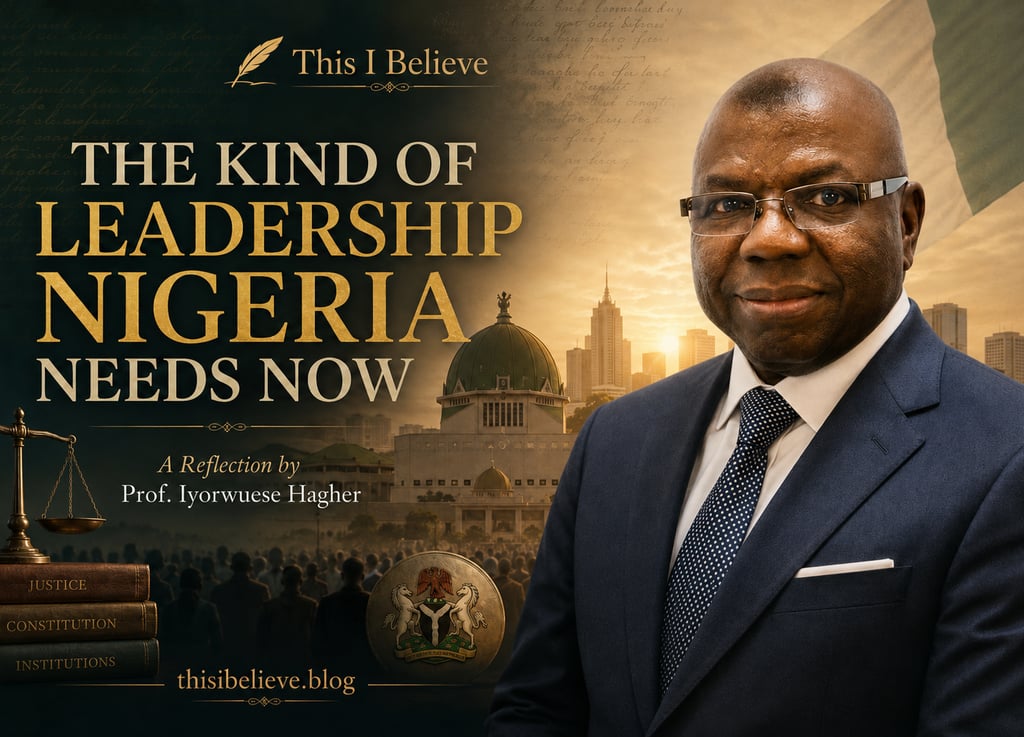
Nigeria does not need louder leaders.
She needs deeper leaders.
She needs men and women who understand that leadership is not performance, not noise, not entitlement, and not the endless occupation of public office. Leadership is not the decoration of power with protocol. It is not the excitement of convoys, titles, applause, security details, and public ceremonies.
Leadership is a sacred trust.
It is the moral burden of carrying the hopes of millions without becoming intoxicated by power. It is the disciplined use of authority for the protection of human dignity. It is the courage to do what is right, even when what is right is not immediately popular.
The kind of leadership Nigeria needs now is leadership with conscience.
For too long, our public life has been crowded with ambition but starved of moral depth. We have seen people seek power with passion, but govern without tenderness. We have seen offices occupied, but responsibilities abandoned. We have heard beautiful speeches from men whose actions betrayed the very words they spoke.
A nation cannot be rescued by speeches alone.
Nigeria needs leaders whose words and conduct live in the same house.
This is where leadership begins: character.
Before policy, before strategy, before manifestos, before political alliances, there must be character. A leader without character is a danger with authority. He may understand procedure, but he will not understand sacrifice. He may control institutions, but he will not build them. He may command attention, but he will not command respect.
Character is the foundation upon which all serious leadership rests.
Without character, intelligence becomes manipulation. Wealth becomes arrogance. Power becomes oppression. Loyalty becomes servitude. Politics becomes trade. Governance becomes theatre.
Nigeria needs leaders who are not afraid of truth.
This may sound simple, but it is one of the rarest qualities in public life. Many leaders want praise, not counsel. They want agreement, not wisdom. They want crowds, not citizens. They want loyalists who will clap even when the house is burning.
But no leader is safe among people who cannot tell him the truth.
And no nation is safe when truth becomes an enemy of power.
The leader Nigeria needs now must be able to listen to uncomfortable voices. He must understand that criticism is not always hatred. Sometimes, criticism is patriotism wearing a painful face. A serious leader does not silence the alarm because the sound is unpleasant. He asks why the alarm is ringing.
Nigeria needs leadership that listens before it commands.
The poor are speaking. The youth are speaking. Farmers are speaking. Workers are speaking. Teachers are speaking. Doctors are speaking. Entrepreneurs are speaking. Communities wounded by insecurity are speaking. Families crushed by hardship are speaking.
The question is whether leadership is listening.
A leader who does not listen will eventually govern an imaginary country. He will sit in comfort and believe the nation is stable because those around him are comfortable. He will mistake prepared briefings for reality. He will confuse praise from beneficiaries with the voice of the people.
Nigeria cannot afford leaders who live far from the pain of the citizens.
The kind of leadership Nigeria needs now must remember the human being behind every policy. Behind every economic decision is a market woman trying to feed her children. Behind every failed road is a farmer unable to move produce to market. Behind every closed school is a child whose future is being quietly stolen. Behind every hospital without medicine is a family standing between hope and grief.
Governance loses its soul when citizens become statistics.
Leadership must therefore be human before it becomes technical. Numbers matter. Budgets matter. Data matters. Planning matters. But the final purpose of all public policy is the improvement of human life. If the people become poorer, more afraid, more divided, and more hopeless, then no leader should hide behind grammar.
The people know when life is hard.
They may not always speak in the language of economists, but they understand the price of food, the fear of insecurity, the burden of school fees, the shame of unemployment, and the silence of abandoned promises.
Nigeria needs leaders who respect this knowledge.
The kind of leadership Nigeria needs now must be competent.
Good intentions are not enough. Compassion without competence may produce sympathy, but it will not produce transformation. A leader must know how to organise people, ideas, institutions, resources, and time. He must be able to choose capable hands and allow them to work. He must understand that public office is not a reward for personal loyalty, but a responsibility that demands capacity.
A country cannot be built by sentiment alone.
It requires discipline. It requires planning. It requires evidence. It requires honest execution. It requires the humility to learn from failure and the courage to correct mistakes before they become national disasters.
Competence is a moral issue.
When incompetence governs, people suffer. Roads collapse. Schools decay. Hospitals fail. Security weakens. Businesses die. Young people lose hope. The cost of bad leadership is not abstract. It is paid daily in human pain.
Nigeria also needs leadership that can build institutions rather than personalities.
One of our recurring tragedies is the excessive personalisation of power. We often build politics around individuals rather than systems. We make men larger than offices and offices weaker than men. Then, when the man leaves, the structure collapses because it was never truly institutional.
A serious leader does not fear strong institutions.
He builds them.
He understands that a nation becomes stable when laws are stronger than moods, systems stronger than favourites, and public interest stronger than private appetite. The leader who weakens institutions to protect himself may enjoy temporary power, but he damages the future of the country.
Nigeria needs leaders who know that power is temporary, but history is permanent.
The convoy will one day stop. The applause will fade. The office will change hands. The title will belong to another. The same corridors that once opened with urgency will become silent. What remains is not the noise of the moment, but the record of one’s choices.
What did power do in your hands?
Did it heal or wound?
Did it build or destroy?
Did it unite or divide?
Did it protect the weak or serve the powerful?
These are the questions history asks when ceremony is over.
The kind of leadership Nigeria needs now must rise above tribe, religion, and narrow interest. Nigeria is too large, too wounded, and too full of possibility to be governed by small thinking. A leader who sees citizens first as ethnic groups, religious blocs, voting units, or political territories has already failed the moral test of nationhood.
Nigeria needs leaders who can see the whole country.
Leaders who understand that justice in one region strengthens peace in another. Leaders who know that insecurity anywhere is a warning to everyone. Leaders who recognise that poverty does not respect tribe, hunger does not respect religion, and despair does not ask for party membership before entering a home.
We need leaders with a national imagination.
Not leaders who merely manage division, but leaders who heal it.
Not leaders who exploit fear, but leaders who reduce it.
Not leaders who inherit bitterness, but leaders who enlarge the space for trust.
Leadership, at its best, is the art of making people believe again without deceiving them.
This is why Nigeria needs leaders who can speak honestly about hardship while offering credible hope. False comfort is not leadership. Empty optimism is not leadership. A leader must not pretend that suffering is not real. But he must also not surrender the nation to despair.
Hope must be disciplined by truth.
Truth must be lifted by vision.
Vision must be supported by action.
The Nigerian people have heard many promises. What they need now is visible seriousness. They need leaders who do not merely announce reforms, but explain them, humanise them, monitor them, correct them, and ensure that the burden of change does not fall only on the poor.
A reform that has no compassion will create anger.
A policy that has no communication will create suspicion.
A government that has no trust will struggle even when it means well.
Trust is one of the greatest currencies of leadership. Once lost, it is difficult to restore. Citizens must believe that their leaders are not playing games with their lives. They must believe that sacrifice is shared, not imposed. They must believe that those who ask the people to endure are also willing to show restraint, humility, and discipline.
Nigeria needs leadership by example.
A leader cannot preach sacrifice from the palace of excess. He cannot ask citizens to tighten their belts while public waste expands. He cannot ask the youth to believe in hard work while rewarding mediocrity and impunity. He cannot fight corruption with selective anger. He cannot build national trust while protecting private wrongdoing.
Example is the most powerful speech a leader can give.
The kind of leadership Nigeria needs now must also be imaginative. Our problems are old, but the world has changed. Technology, climate change, artificial intelligence, global markets, youth unemployment, migration, insecurity, and cultural fragmentation have created new pressures. Old habits will not solve new realities.
We need leaders who can think beyond yesterday.
Leaders who can turn youth creativity into productivity. Leaders who can connect education to the future of work. Leaders who can modernise agriculture, secure communities, support enterprise, strengthen digital capacity, and turn Nigeria’s diversity into a source of strength rather than fear.
Leadership must not only manage crisis.
It must design the future.
But above all, Nigeria needs moral leadership.
Leadership that understands that a country is not merely a territory. It is a covenant between the living, the dead, and the unborn. Those who govern today are trustees of sacrifices made yesterday and possibilities expected tomorrow.
To lead Nigeria is to carry history.
It is to remember those who died believing this country could become better. It is to remember the children yet unborn who will inherit either our wisdom or our recklessness. It is to remember that power is not ownership. It is stewardship.
The leader Nigeria needs now must have the humility to know that he is not the nation.
He is only a servant of its destiny.
Nigeria will not be saved by one man alone. No nation is. But leadership matters because it sets the moral temperature of public life. When leaders are serious, citizens are encouraged to be serious. When leaders are disciplined, institutions begin to breathe. When leaders are truthful, public trust begins to return. When leaders are humane, the nation remembers its soul.
Nigeria does not need perfect leaders.
There are none.
But Nigeria urgently needs honest leaders, competent leaders, courageous leaders, listening leaders, fair leaders, imaginative leaders, and morally awake leaders.
Leaders who know that power without conscience is danger.
Leaders who know that leadership without service is vanity.
Leaders who know that history is watching.
The kind of leadership Nigeria needs now is not leadership that shouts the loudest.
It is leadership that carries the deepest responsibility.
Leadership that sees the poor.
Leadership that respects truth.
Leadership that builds institutions.
Leadership that unites difference.
Leadership that chooses justice over convenience.
Leadership that remembers that the nation is not an inheritance to be consumed, but a trust to be honoured.
Nigeria is still possible.
But possibility requires leadership with character.
And character, in the end, is the first constitution of every great nation.