
The Scholar and the Village Boy
A deeply human reflection on how village roots, discipline, education, and memory shape the journey from humble beginnings to scholarship and public service.
LIFE
Iyorwuese Hagher
5/24/20266 min read
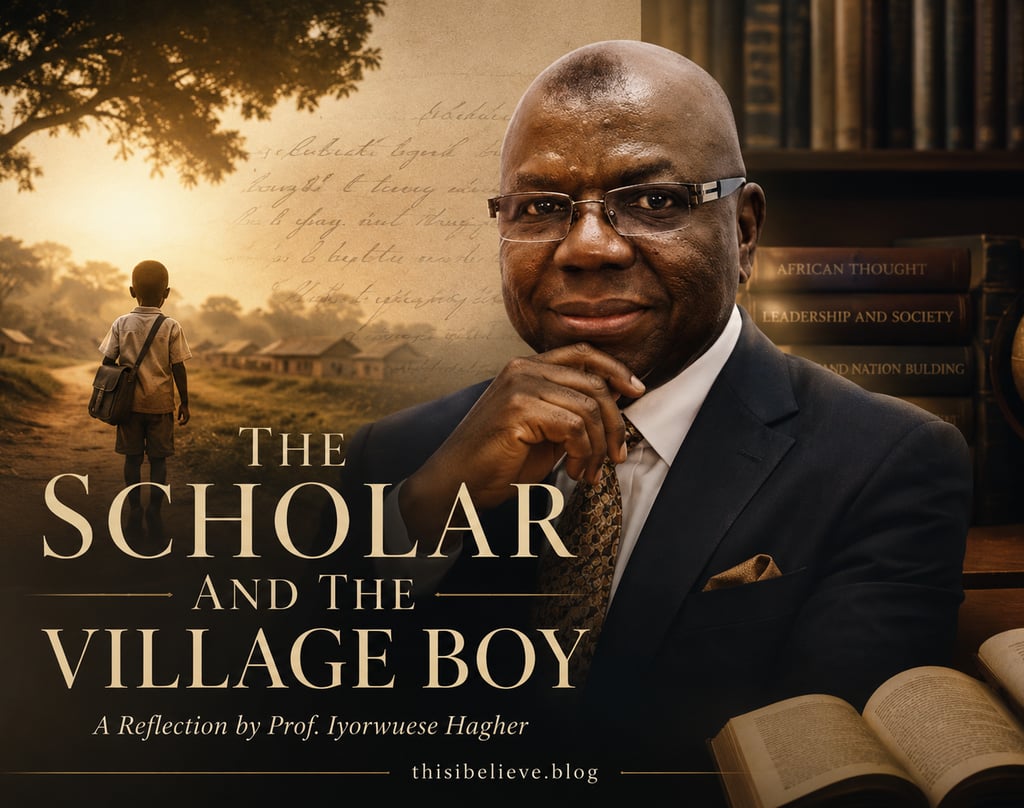
There is a village boy inside every scholar who remembers where he came from.
He may wear a suit. He may sit before books. He may speak in universities, parliaments, embassies, conferences, and public halls. His name may be written with titles that society respects. But somewhere beneath the formal clothing and public recognition, there remains a child who once looked at the world with wonder, hunger, fear, hope, and questions.
I know that boy.
He followed dusty paths before he entered lecture halls. He heard the language of elders before he read the language of philosophers. He learned from silence before he learned from books. He watched women carry burdens with grace, men wrestle with hardship, children laugh in poverty, and communities survive by memory, discipline, and faith.
That village boy did not know that one day people would call him professor.
He did not know that books would become his companions, that ideas would become his tools, that public service would place him before the difficult questions of nationhood, leadership, culture, justice, and human dignity.
He only knew that life was asking him to pay attention.
And perhaps that was the beginning of scholarship.
Before a man becomes a scholar, he must first become a listener.
The village teaches listening.
It teaches you to listen to the sound of footsteps, to the mood of the sky, to the wisdom hidden in proverbs, to the meaning of a mother’s tired silence, to the authority in an elder’s pause. The village may not always have libraries, but it has memory. It may not always have laboratories, but it has experience. It may not always have written theories, but it has human truth.
Many people think education begins when a child enters school.
I disagree.
Education begins when a child begins to notice.
The village boy notices everything because his survival depends on it. He notices who eats first and who eats last. He notices who speaks and who is silenced. He notices injustice before he can define it. He notices dignity before he can write about it. He notices power long before he understands politics.
This is why the village boy must never be despised.
He carries the raw material of wisdom.
The tragedy of modern life is that many people want to become educated by escaping their roots completely. They imagine that progress means forgetting the village, mocking the old ways, abandoning the language of their mothers, and pretending that civilization began only when they entered the city.
But a tree that is ashamed of its roots cannot stand in a storm.
The scholar who forgets the village becomes clever but empty. He may speak beautifully, but his words will not carry soil. He may quote the world, but he will not understand his people. He may acquire degrees, but he will lose the moral texture of lived experience.
True scholarship does not erase origin.
It refines it.
The village gave me questions. The university gave me methods. Life gave me evidence. Public service gave me consequence.
Together, they formed a journey.
I have often thought about the distance between the village path and the scholar’s desk. It is not only a physical distance. It is a moral distance, a spiritual distance, an intellectual distance. One must travel from innocence to understanding, from hunger to discipline, from observation to interpretation, from ambition to responsibility.
But the journey is dangerous if one forgets the first road.
I remember the village not as a place of perfection, but as a place of formation. There was hardship. There were limitations. There were fears. There were things we did not have. But there was also community. There was moral instruction. There was a sense that one’s life belonged not only to oneself, but also to others.
In the village, success was never entirely private.
If a child rose, the family rose in hope. If a young person entered school, the community watched with expectation. If one returned with knowledge, one was expected to return with usefulness.
That is a lesson our age must recover.
Knowledge that does not serve is vanity.
Education that does not humanize is incomplete.
Power that does not protect dignity is failure.
The scholar must remain accountable to the village boy because the village boy remembers the people whom theories often forget. He remembers the woman walking miles for water. He remembers the child sitting under a tree to learn. He remembers the farmer whose labour feeds the nation but whose name never appears in policy documents. He remembers the poor, not as statistics, but as faces.
This memory is important.
A nation becomes unjust when its educated class forgets the ordinary people.
The purpose of education is not to make us superior to those who did not have our opportunities. The purpose of education is to make us more responsible. Every degree should deepen humility. Every title should enlarge service. Every achievement should ask: who is still left behind?
The village boy asks this question.
The scholar must answer it.
That is why I have always believed that intellectual life must not be separated from public morality. Books are not decorations. Ideas are not ornaments. Words are not empty sounds. Scholarship must enter the bloodstream of society. It must challenge falsehood. It must comfort the wounded. It must disturb the arrogant. It must give language to the voiceless.
A scholar is not merely one who knows.
A scholar is one who sees.
He sees history beneath events. He sees systems beneath suffering. He sees culture beneath behaviour. He sees the child behind the statistic. He sees the village behind the nation.
And if he is honest, he sees himself still walking that old road between memory and responsibility.
The village boy inside me has never disappeared.
He still asks why some children are denied the dignity of good education. He still asks why leadership often forgets the poor after elections. He still asks why communities that produce food remain hungry for development. He still asks why those who rise sometimes close the door behind them.
He still asks why Nigeria, with all her promise, continues to wound the very people who love her most.
These questions have followed me through classrooms, theatres, books, politics, diplomacy, and public life. They are not academic questions alone. They are human questions. They are national questions. They are moral questions.
And they are the reason I write.
Writing, for me, is not merely expression. It is remembrance. It is testimony. It is an attempt to gather the fragments of experience and offer them back to society as reflection.
When I write about leadership, I remember the village boy who saw authority before he understood power.
When I write about nationhood, I remember the village boy who saw community before he understood the state.
When I write about creativity, I remember the village boy who heard stories before he studied literature.
When I write about life, I remember the village boy who learned that survival without meaning is not enough.
This is why memory matters.
A people without memory become easy victims of deception. A leader without memory becomes dangerous. A scholar without memory becomes rootless. A nation without memory repeats its wounds and calls them destiny.
We must teach our young people to rise, but not to forget.
Let them enter universities, laboratories, studios, courtrooms, parliaments, ministries, companies, and global institutions. Let them master technology, science, literature, governance, commerce, and innovation. Let them compete with the world.
But let them also remember the village.
Let them remember the grandmother’s prayer, the father’s sacrifice, the mother’s endurance, the neighbour’s kindness, the teacher’s discipline, the community’s expectation.
Let them remember that no one rises alone.
There is always a hand, a voice, a sacrifice, a path, a place.
The scholar and the village boy are not enemies. They are companions. The scholar gives language to what the village boy felt. The village boy gives humanity to what the scholar knows.
Together, they make a complete man.
Perhaps this is the lesson I wish to leave with every young person: do not be ashamed of your beginning. Do not despise the small place that first taught you courage. Do not measure your roots by poverty alone. Sometimes the poorest soil produces the strongest trees.
The village may not have given you everything.
But it may have given you the eyes with which to see.
And in a world crowded with noise, ambition, vanity, and speed, the ability to see deeply is still one of the highest forms of wisdom.
I remain grateful for the scholar’s journey.
But I remain even more grateful for the village boy who began it.
He keeps me human.
He keeps me listening.
He keeps me remembering that knowledge must bend toward service, and that the highest education is not the one that takes a man away from his people, but the one that sends him back to them with deeper love, clearer truth, and greater responsibility.
Read more reflections at thisibelieve.blog.