THE SUPREME COUNCIL FOR SHARI’AH IN NIGERIA’S HIGHWAY TO NATIONAL DISINTEGRATION.
Nigeria’s democracy rests on a single, non-negotiable foundation: free and credible elections. The recent declaration by the Supreme Council for Shari’ah in Nigeria—calling for the removal of the Chairman of the Independent National Electoral Commission, Prof. Joash Amuputan, and threatening to reject any election conducted under his leadership—goes far beyond criticism of an individual officeholder. It strikes at the heart of democratic governance itself.
NATIONHOOD
Prof. Iyorwuese Hagher
2/4/20266 min read
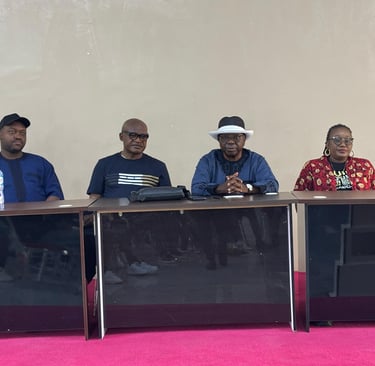
By Prof. Iyorwuese Hagher, OON.
The recent declaration by the Supreme Council for Shari’ah in Nigeria—calling for the removal of the current Chairman, Prof. Joash Amuputan of the Independent National Electoral Commission, and threatening non-recognition of any election conducted under him—does not merely challenge a public official. It challenges the most sensitive aspect of Nigeria’s democracy. Without elections, there is no democracy!
In his 2020 legal brief, “Genocide in Nigeria-The implication for the International Community”, Prof. Joash Amuputan claimed that Christians in Nigeria are facing genocide, citing violence by Boko Haram and Fulani herdsmen. The SCSN declaration has introduced the most extreme case of political Islam, in which, after all due diligence is applied and candidates are voted on by the Senate and approved by the president, a final religious veto can be wielded. A veto so consequential that it could lead to national disintegration. Non-recognition of any election by the Muslim Ummah would mean a global contestation of political power between Islamic and non-Islamic countries. This would inevitably lead to violence, chaos, and the destruction of Nigeria’s fragile democracy.
Let us be clear: in a democracy, disagreement is not a threat. Protest is not a sin. Criticism of public officials is not only permitted but necessary. Nigeria’s democracy is young, imperfect, and often bruised by its own contradictions. Yet it remains one of the few shared spaces where citizens of different tongues, creeds, and histories meet as equals. Nigerian Christians and Muslims have managed this complexity through healthy competition and political power-sharing. Even when traditional power-sharing agreements are flouted and Muslim-Muslim presidential tickets emerge, Christian politicians still vote massively for such candidates. In the past, when candidates for ministerial appointment were alleged to be tainted by Islamic extremism, such as Prof. Isa Ali Ibrahim Pantami, who was alleged to have expressed support for the Taliban and Al-Qaeda, he was still appointed to one of the most sensitive cabinet positions in the Nigerian government. This was not a weakness. It was the ability to manage diversity with sensitivity.
Throughout the histories of FEDECO, NEC, and INEC, the Chairmen have always been professors and jurists, mostly from the South-South and Eastern Zones. The roll call: Justice Victor Ovie-Whisky, 1980-1983; Prof. Eme Awa, 1987-1989; Sumner Dagogo-Jack, 1994-1998; Justice Ephraim Akpata, 1998-2000; Dr Abel Goubadia, 2000-2005; and Prof. Maurice Iwu, 2005-2010. In 2010, with a South-South President, Goodluck Jonathan, the Chairmanship moved to the Northern Zones for the first time. Professor Attahiru Jega served two terms, 2010-2015, and then the Chairmanship moved to the North-East: Prof. Mahmoud Yakubu served two more terms, 2015-2025. These northern intellectuals were Muslims. Now, with the North Central Zone having a Chairman of INEC from Kogi State, a Christian, Prof. Joash Amuputan, the loud dissent from the Sharia Council is framed in the vocabulary of faith as a collective command to delegitimise future elections! This dissent, coming after the political due process is complete, appears to lose sight of our geopolitical sensitivity and the professor’s rights as a scholar and a legal luminary (Senior Advocate of Nigeria) to hold personal views and to represent clients in briefs. This dissent has moved from the realm of healthy civic engagement into the perilous territory of moral coercion and absolutism. This is not democracy; it is theocracy and the weaponisation of religion. It is Political Islam.
The politicisation and weaponisation of religion in the world today are rolling back democracy and giving rise to absolutism and dictatorship. Christian and Muslim countries are equally guilty. In the USA, for instance, the rise of Christian nationalism has been linked to the suppression of voter and minority rights and to challenges to secular governance. In Poland, the Law and Justice party, in alliance with Catholic conservative groups, is suppressing minority rights, the media, and free speech. In Hungary, the ruling Fidesz party has influenced the policies of Christian conservative groups on immigration and free speech.
Political Islam has enabled the formation of theocratic dictatorships, the suppression of dissent, and restrictions on freedoms and women’s rights, as evident in Iran since the 1979 revolution. In Pakistan, we see the rise of political Islam, which restricts free speech through blasphemy laws and promotes sectarian violence. In Turkey, President Erdogan’s political Islam has affected secularism and press and judicial freedoms. Nigeria does not need to follow these examples. We need not take this highway to national disintegration. We are a unique and delicate democracy, trying to weave a rich democratic tapestry from our rich diversity.
The ballot is not a Christian instrument. It is not a Muslim one. It is not the property of any sect, council, or cause. It is a civic covenant—fragile yet precious—that binds all Nigerians together in the simple, stubborn belief that our future should be chosen, not imposed. Threatening the legitimacy of that covenant on religious grounds risks turning political disagreement into a theological fault line. History, both within and beyond our borders, warns us of what happens when the sacred is conscripted to serve political grievance. It rarely ends in justice. It often ends in silence, fear, and the slow erosion of trust.
The question before us is not whether Professor Joash Amupitan, like any public servant, should be subject to scrutiny. Of course, he should. No office in a democracy is beyond examination. The question is how that scrutiny is pursued. Our constitution does not grant any group—religious, ethnic, or ideological—the authority to pre-empt the courts, the legislature, or the established mechanisms of accountability. It grants us institutions, imperfect as they may be, precisely so that disputes can be resolved without resorting to ultimatums.
There is a deeper, more troubling undertone in this episode: the growing temptation to define national loyalty through the lens of belief. This is not new. It has haunted our post-independence journey, appearing in different guises over time. Yet every time it resurfaces, it weakens the moral centre of our republic. It teaches young Nigerians that the path to influence lies not in argument, evidence, or civic participation, but in mobilising identity as a weapon. Faith, at its best, is a wellspring of conscience. It calls us to humility, restraint, and recognition of the dignity of those who do not share our convictions. When it is instead used as a megaphone for political pressure, it risks losing that moral altitude. It becomes another instrument in the crowded marketplace of power.
I write this not as a defender of any individual, but as a custodian, however modest, of a larger idea: that Nigeria’s future depends on our ability to argue without excommunicating, to disagree without delegitimising, and to demand accountability without threatening the foundations of the system that allows us to make such demands in the first place. If there are legal questions about the conduct or past statements of the INEC Chairman, the courts are there to address them. I believe Professors Attahiru Jega, Mahmoud Yakubu, and Joash Amuputan, my younger academic colleagues and the privileged few to serve as INEC Chairmen, stand with me on the larger idea and the bigger picture of a Nigeria that is an honourable and just society. Let us give Prof Joash Amuputan a chance to chair INEC in peace.
If there are concerns about the integrity of the electoral process, civil society, the media, and the legislature have roles to play. These are the channels through which democracies breathe. When we bypass them in favour of collective declarations of non-recognition, we risk suffocating the very system we claim to protect.
There is also a moral responsibility that comes with leadership—religious or otherwise—to weigh the consequences of public pronouncements. In a country where tensions can ignite with alarming speed, words can become sparks. Those who occupy platforms of influence, such as the Supreme Sharia Council, must ask themselves not only “Is this true?” and “Is this just?” but also “What will this do to the fragile peace we share?” Nigeria does not need another season of mutual suspicion. It needs a renewed commitment to the slow, often frustrating work of building institutions that outlast individuals and transcend identities. It needs voices that lower the temperature, not raise it; that widen the circle of belonging, not shrink it.
The test of our democracy is not whether we can hold elections in perfect harmony. It is whether, amid our disagreements, we can still recognise each other as fellow citizens bound by a common destiny. The ballot box, for all its flaws, remains one of the few places where that recognition is evident. To threaten it is to threaten ourselves. Let us, therefore, return to the harder, nobler path: lawful challenge, patient reform, and moral persuasion.
Let faith inspire our conscience, not commandeer our constitution. Let criticism sharpen our institutions, not fracture our unity. As one blessed with decades of national public service at the highest levels, I stand for a united, secular, and democratic Nigeria, a great Nigeria that teaches the world how to manage diversity. I do not support Political Christianity or Political Islam.
In the end, Nigeria’s future will not be secured by those who refuse to recognise an election, but by those willing to recognise in every other Nigerian a partner in the long, unfinished journey towards a more just, more inclusive, and more credible republic.
Iyorwuese Hagher OON.