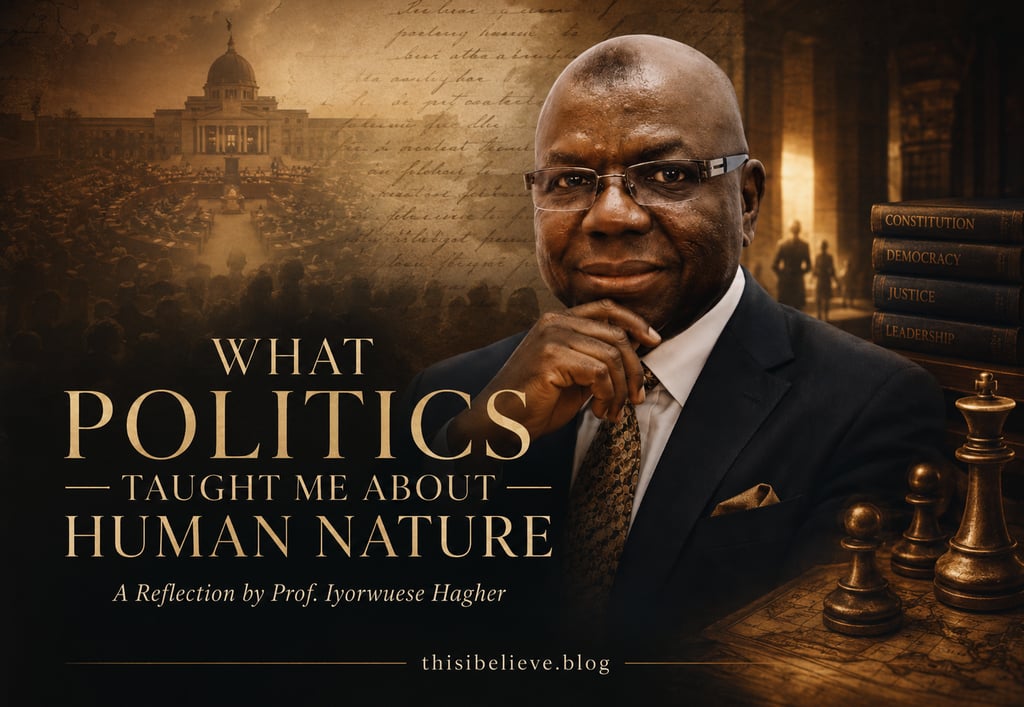
What Politics Taught Me About Human Nature
A reflective essay by Prof. Iyorwuese Hagher on what years in governance and public life reveal about ambition, loyalty, fear, courage, truth, and human nature.
Iyorwuese Hagher
5/25/20267 min read
Politics is not only the struggle for power.
It is also the theatre where human nature removes its mask.
In ordinary life, people often hide behind manners, friendships, titles, smiles, and carefully chosen words. But politics has a strange way of exposing what is hidden. It reveals courage and cowardice. It reveals loyalty and betrayal. It reveals greed and sacrifice. It reveals the difference between those who seek power to serve and those who seek power to be worshipped.
I have spent enough years around public life to know that politics does not create every weakness in a person. More often, it amplifies what was already there.
Power is a magnifying glass.
It enlarges the soul.
If a man is generous, power gives him a larger field for generosity. If he is cruel, power gives his cruelty instruments. If he is humble, power becomes service. If he is vain, power becomes theatre. If he is greedy, power becomes a marketplace. If he is insecure, power becomes a weapon against imagined enemies.
This is one of the first lessons politics taught me: power does not change people as much as it reveals them.
Many people enter politics speaking the language of service. They speak of the people, the poor, the nation, the future, the youth, and the common good. These words are necessary. But words are cheap in the mouth of ambition.
The true test of a leader is not what he says when he is seeking power. It is what he remembers after power has entered his hands.
Does he still hear the cry of ordinary people?
Does he still respect truth?
Does he still welcome correction?
Does he still remember the village, the classroom, the marketplace, the farmer, the widow, the unemployed graduate, the sick child, the forgotten community?
Or does he begin to believe that the nation exists to honour his ego?
Politics taught me that the human being is capable of great nobility and frightening selfishness. I have seen men and women sacrifice comfort for the public good. I have seen people defend justice at great personal cost. I have seen quiet servants of the republic work without applause, often unknown and uncelebrated.
But I have also seen friendship sold for appointment, conscience exchanged for access, truth buried for convenience, and public trust reduced to private opportunity.
This is why politics must never be romanticised.
It is serious business because it deals with human life. Behind every policy are people. Behind every budget are communities. Behind every failure of governance are children who may never recover what was stolen from their future.
Bad politics is not merely inefficient. It is immoral.
When leadership fails, the poor pay first.
Politics also taught me that ambition is not evil by itself. A society without ambition will stagnate. Nations need men and women who desire to build, lead, organise, imagine, and achieve. But ambition without conscience is dangerous.
Ambition must be disciplined by values.
A leader may desire office, but he must not desire it more than truth. He may desire influence, but he must not desire it more than justice. He may desire victory, but he must not desire it more than the dignity of the people.
When ambition becomes greater than character, politics becomes a threat to the nation.
I have seen this too often. People who once spoke against injustice become silent when injustice benefits them. People who condemned arrogance begin to practise it when power smiles in their direction. People who demanded fairness suddenly discover complicated excuses when fairness requires sacrifice from them.
Human nature is very skilled at self-justification.
The heart can manufacture reasons for almost anything it wants badly enough.
That is why institutions matter. A good society cannot depend only on the personal goodness of leaders. Human beings are fragile. They are tempted by praise, money, loyalty, fear, revenge, and the intoxication of command. Without institutions, power becomes too personal. And when power becomes too personal, the nation becomes vulnerable to the mood of one man.
Strong institutions are society’s way of admitting that human nature must be guided, checked, and disciplined.
Politics taught me another lesson: loyalty is one of the most misunderstood words in public life.
Many people confuse loyalty with silence. They think to be loyal is to agree with everything a leader says, to defend every mistake, to flatter every weakness, and to attack every critic. That is not loyalty. That is servitude.
True loyalty tells the truth before damage becomes disaster.
A loyal adviser is not the one who claps loudest. It is the one who can say, respectfully but firmly, “Sir, this road leads to danger.”
Unfortunately, politics often rewards the flatterer and punishes the truthful. This is why many leaders become surrounded by echoes instead of counsel. They hear their own voice returned to them in different tones, and they mistake that echo for wisdom.
No leader is safe among people who are afraid to tell him the truth.
And no nation is safe when truth becomes an enemy of power.
I learned also that fear is a powerful force in politics. Many people who appear strong in public are governed by fear in private. Fear of losing office. Fear of losing access. Fear of offending powerful people. Fear of being excluded. Fear of poverty. Fear of ridicule. Fear of being alone.
Fear makes good people quiet.
Fear makes intelligent people foolish.
Fear makes honest people compromise.
A society that punishes truth and rewards cowardice will eventually be led by dangerous men and defended by frightened ones.
This is why courage is essential in public life. Not the loud courage of insult, but the quiet courage of conviction. The courage to stand alone when the crowd is wrong. The courage to defend the weak when it is inconvenient. The courage to admit error. The courage to resign rather than participate in evil. The courage to remember that no office is worth the death of one’s soul.
Politics taught me that people are rarely as simple as they appear. The wicked may sometimes do kind things. The kind may sometimes lack courage. The intelligent may be morally weak. The poor may be generous. The rich may be empty. The powerful may be insecure. The ordinary citizen may possess more wisdom than the celebrated statesman.
Human beings are complicated.
This complexity should make leaders humble.
Anyone who governs people must first respect the mystery of people. Citizens are not statistics. They are not crowds to be manipulated during elections and forgotten afterwards. They are human beings with memory, pain, dignity, dreams, and judgment.
One of the greatest failures of leadership is the belief that the people do not understand.
The people may be patient, but they are not blind.
They may be poor, but they are not stupid.
They may be silent, but silence is not consent.
A wise leader studies the silence of the people before it becomes anger.
Politics also taught me the danger of praise. Praise is sweet, but it can poison judgment. Every leader must be careful when applause becomes too constant. Applause can make a man deaf. It can make him mistake popularity for righteousness and noise for legitimacy.
There is nothing wrong with being appreciated. But a leader who lives on praise will soon become afraid of truth.
This is why solitude is important. Every leader must create a private court where conscience can speak. Away from aides, supporters, protocol, cameras, slogans, and praise-singers, a leader must ask himself: What am I becoming? What am I doing with power? Who is suffering because of my silence? Who is benefiting from my weakness? What will history say when the drums stop beating?
The drums always stop.
Politics taught me that time is the final judge of power.
The convoy ends. The office changes hands. The applause fades. The security men salute another person. The chair is occupied by someone else. The files move on. The same people who once stood at attention may no longer pick the phone.
What remains is character.
What remains is the record.
What remains is the memory of those helped or harmed by one’s choices.
This is why public office must be treated as a temporary trust, not a permanent possession. No leader owns power. At best, he borrows it from the people, from history, and from God.
To misuse power is to betray all three.
Yet, despite all I have seen, politics did not make me lose faith in humanity. It made my faith more sober. I no longer expect perfection from people, but I still expect responsibility. I no longer believe that good intentions are enough, but I still believe that good character matters. I no longer romanticise leadership, but I still believe that leadership can redeem a nation when joined with competence, humility, courage, and moral clarity.
Politics showed me the weakness of man.
But it also showed me his possibility.
I have seen people change. I have seen enemies reconcile. I have seen leaders listen. I have seen citizens rise. I have seen truth survive intimidation. I have seen small acts of courage alter the direction of large events.
Human nature is not fixed in darkness.
It can be educated. It can be disciplined. It can be redeemed.
But it must be watched.
That is why societies need memory. We must remember what power does to people. We must remember the cost of silence. We must remember the danger of worshipping leaders. We must remember that no democracy can survive when citizens surrender their judgment to emotion, ethnicity, religion, money, or fear.
Politics is too important to be left only to politicians.
It belongs to citizens, writers, teachers, students, workers, farmers, market women, traditional institutions, religious leaders, artists, journalists, and every person whose life is shaped by decisions made in public offices.
If politics taught me anything, it is this: the struggle for a better nation is ultimately a struggle for better human beings.
Better leaders.
Better citizens.
Better institutions.
Better memory.
Better conscience.
The republic is not built by laws alone. It is built by character. And where character fails, even the best laws become paper.
This is why I still write. This is why I still reflect. This is why I still believe that public conversation matters. A nation that stops examining itself begins to decay quietly.
Politics taught me about ambition, loyalty, fear, courage, betrayal, service, vanity, and truth.
But above all, politics taught me that the human heart must never be trusted without moral discipline.
Power is a test.
Leadership is a burden.
History is a witness.
And character, in the end, is the only office no one can rig.