
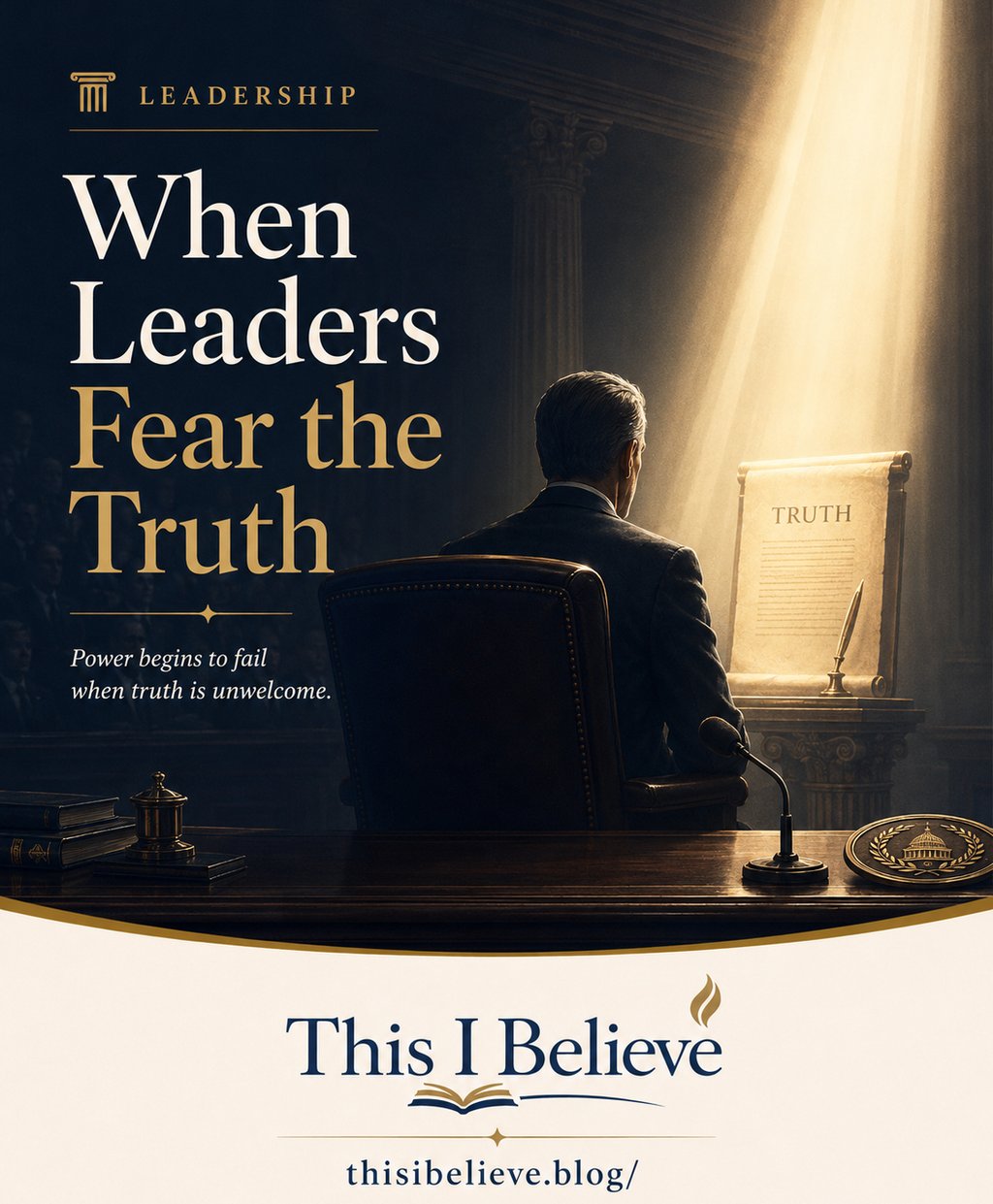
When Leaders Fear the Truth
There is no greater danger to leadership than the fear of truth. A leader may survive criticism. He may survive political opposition. He may survive economic hardship, public anger, institutional weakness, or even the betrayal of allies. But when a leader begins to fear the truth, something deeper has gone wrong. The soul of leadership has begun to decay.
Iyorwuese Hagher
5/18/20266 min read
There is no greater danger to leadership than the fear of truth.
A leader may survive criticism. He may survive political opposition. He may survive economic hardship, public anger, institutional weakness, or even the betrayal of allies. But when a leader begins to fear the truth, something deeper has gone wrong. The soul of leadership has begun to decay.
Truth is not always pleasant. It does not always arrive dressed in praise. Sometimes truth comes through a difficult report, a courageous adviser, a grieving citizen, a restless youth, a wounded community, a protesting worker, a failed policy, or an uncomfortable silence in the room. Truth may appear as accusation, warning, correction, or revelation. But however it comes, wise leadership must not run away from it.
The leader who fears the truth begins to build his own prison.
He surrounds himself with praise singers. He rewards those who flatter him and distances those who correct him. He mistakes loyalty for silence and criticism for hostility. He prefers reports that massage his ego rather than facts that expose reality. Gradually, the palace becomes quiet—not because all is well, but because everyone has learned the danger of speaking honestly.
This is how nations fail.
Not always because leaders do not know what is wrong, but because they do not want to hear it clearly enough to act.
A leader who fears the truth becomes a prisoner of illusion. He begins to govern an imaginary country, not the real one. In the imaginary country, the people are happy, policies are working, institutions are strong, insecurity is exaggerated, corruption is propaganda, poverty is misunderstood, and every critic is an enemy. But outside the walls of official comfort, the real country continues to suffer.
The hungry do not eat propaganda.
The unemployed do not survive on slogans.
The insecure do not sleep safely because leaders have declared peace in speeches.
The wounded do not heal because power refuses to acknowledge their pain.
Truth has a stubborn life. It does not disappear because it is denied. It only waits. And when truth is buried too long, it returns as crisis.
This is one of the most important lessons of leadership: what is refused in honesty often returns in disaster. A leader who refuses to listen to early warnings will eventually listen to explosions. A government that refuses to hear complaints will eventually confront revolt. An institution that suppresses internal criticism will one day face public disgrace. A family that hides its wounds will eventually break under the weight of its silence.
Truth is cheaper when it is heard early.
But weak leaders prefer comfort. They do not want the burden of correction. They want the beauty of office without the discipline of accountability. They want authority without examination. They want loyalty without conscience. They want the people to clap while the foundations crack.
This is not leadership. It is theatre.
True leadership requires the courage to face reality. It requires the humility to ask difficult questions. It requires the moral strength to say, “We were wrong.” It requires the wisdom to understand that correction is not humiliation. It requires the maturity to know that no leader, however intelligent, experienced, or powerful, sees everything.
A leader who cannot be corrected is already dangerous.
Such a leader may begin with confidence, but he ends in arrogance. He may begin with public support, but he ends in isolation. He may begin with noble intentions, but he ends by defending the very things he once condemned. This is because truth is the mirror that keeps power human. Once that mirror is removed, power begins to admire itself excessively.
And power that admires itself too much soon becomes cruel.
In Africa, we have seen this tragedy repeatedly. Leaders who came to office promising renewal gradually became allergic to criticism. They called every warning sabotage. They called every dissent betrayal. They treated the press as enemies, intellectuals as irritants, civil society as opposition, and citizens as children who must be managed rather than heard.
But no serious nation can grow where truth is treated as treason.
A society needs citizens who can speak. It needs journalists who can investigate. It needs scholars who can question. It needs artists who can reveal. It needs elders who can warn. It needs young people who can challenge inherited failures. It needs institutions that can tell a leader what he needs to hear, not merely what he wants to hear.
When leaders fear the truth, institutions also become afraid.
Civil servants learn to edit reality. Advisers learn to manufacture optimism. Security reports become political documents. Budgets become ceremonies of imagination. Statistics become instruments of deception. Public communication becomes a machine for managing perception rather than confronting reality.
This is how falsehood becomes administrative culture.
And once falsehood enters administration, governance loses contact with the people.
The leader may still sit in office. Convoys may still move. Cameras may still record. Protocol may still function. Speeches may still be delivered. But beneath the surface, public trust begins to die. Citizens listen, but they no longer believe. They watch, but they no longer expect. They obey when forced, but their hearts withdraw from the moral authority of the state.
A leader should fear this more than criticism.
Criticism may be noisy, but distrust is deadly. A people who distrust leadership become difficult to mobilize. They no longer believe promises. They no longer respect sacrifice because they suspect manipulation. They no longer see public policy as common effort, but as another arrangement for private benefit.
Truth is the foundation of trust.
Where truth is absent, leadership becomes performance. And performance cannot build a nation.
It is important to say that truth must also be spoken responsibly. Not every insult is truth. Not every rumor is courage. Not every accusation is justice. A society must distinguish between honest criticism and malicious destruction. Those who speak truth must do so with evidence, seriousness, and a sense of public responsibility.
But the abuse of criticism must not become an excuse for the fear of criticism.
Leaders often hide from truth by attacking the messenger. Instead of asking whether the complaint is valid, they ask who is speaking. Instead of examining the wound, they examine the tribe, party, religion, region, or personal history of the one who complains. This is a dangerous habit. Even an enemy may tell the truth. Even a critic may see what friends are afraid to say.
Wisdom does not reject medicine because it came from an unpleasant hand.
The mature leader listens beyond ego.
He listens to the tone, but he also listens for the truth inside it. He does not demand that every warning arrive with perfect politeness before he takes it seriously. He knows that citizens who have suffered for long may not always speak with diplomatic softness. Pain has its own language.
A leader must learn to hear pain without becoming defensive.
This is the beginning of moral authority.
Leadership is not proved by the number of people who praise you. It is proved by the number of difficult truths you can endure without losing your balance. A leader who can sit with uncomfortable facts, admit mistakes, change course, and correct injustice is stronger than the leader who pretends everything is perfect.
Truth does not weaken leadership. Truth purifies it.
A leader who loves truth may lose flatterers, but he will gain credibility. He may face temporary embarrassment, but he will avoid deeper shame. He may be forced to revise policies, but he will save the future from larger damage. He may not always appear powerful, but he will become trustworthy.
And trust is greater than fear.
This applies not only to presidents, governors, ministers, and public officials. It applies to all forms of leadership. A father who fears the truth will damage his household. A pastor who fears the truth will weaken his ministry. A university administrator who fears the truth will ruin intellectual life. A business owner who fears the truth will destroy his organization. A community leader who fears the truth will betray his people.
Wherever there is authority, truth must be welcome.
This is why leaders need people around them who are not hungry for favour. They need advisers with moral backbone. They need friends who can speak without trembling. They need institutions strong enough to resist personal pressure. They need systems that make honesty safer than flattery.
No leader should be surrounded only by those who benefit from his blindness.
The greatest service anyone can render to a leader is not praise. It is truthful counsel. Praise may comfort him for a moment, but truth may save his legacy. Praise may make him feel loved, but truth may prevent him from becoming unjust. Praise may decorate the present, but truth protects the future.
There is also a spiritual dimension to this matter. The fear of truth is often the fear of judgment. It is the fear that the image we have created cannot survive the facts. It is the fear that our decisions, motives, failures, and compromises will be exposed. But no image is worth preserving at the cost of the soul.
A leader must prefer painful truth to beautiful deception.
For deception is a soft bed that leads to ruin.
The leader who welcomes truth may be wounded by it, but he will not be destroyed by illusion. He will grow. He will adjust. He will become more human. He will understand that authority is not perfection, but responsibility. He will know that the people do not need a leader who never fails; they need a leader honest enough to confront failure.
When leaders fear the truth, nations become unsafe.
When leaders welcome the truth, renewal becomes possible.
This is the great choice before every person in authority: to build a palace of praise or a house of integrity; to surround oneself with comfort or with conscience; to silence the messenger or heal the wound; to govern appearances or confront reality.
History is watching.
The people are watching.
Time is watching.
And truth, whether feared or welcomed, will eventually speak.