
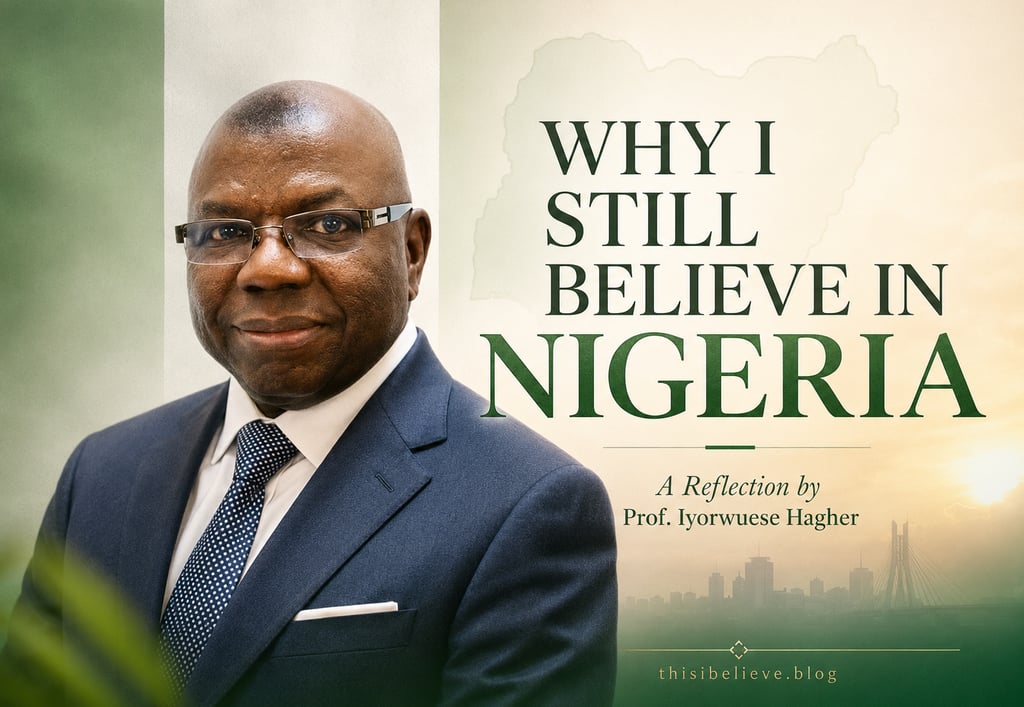
Why I Still Believe in Nigeria
A reflective essay on why Nigeria, despite its failures, remains a nation of possibility, resilience, moral courage, and unfinished promise.
NATIONHOODGENERALLEADERSHIP
Iyorwuese Hagher
5/23/20266 min read
There are countries one supports because they are easy to love.
Nigeria is not one of them.
Nigeria tests the patience of her believers. She wounds the hopes of her children. She exhausts even those who have served her with honesty, sacrifice, and faith. She has a way of making the patriot appear naïve and the cynic appear wise.
Yet, after all these years, I still believe in Nigeria.
I do not believe in Nigeria because I am blind to her failures. I have seen too much of public life to romanticise our condition. I have seen promises made loudly and broken quietly. I have seen institutions weakened by greed, leadership reduced to performance, and citizens forced to carry burdens that should have been lifted by the state.
I have seen young people lose faith, not because they are lazy, but because the country has too often failed to reward their intelligence, discipline, and courage. I have seen honest workers become tired of honesty. I have seen communities abandoned to insecurity. I have seen poverty sit comfortably beside obscene wealth. I have seen our public conversation become louder while our moral imagination grows weaker.
Still, I believe.
I believe because Nigeria is more than the conduct of those who misuse her name. Nigeria is not merely the government of the day, the crisis of the hour, the argument of politicians, or the frightening headlines that greet us in the morning.
Nigeria is a deep historical possibility still struggling to become a moral nation.
She is the farmer who plants again after flood and drought.
She is the teacher who enters a classroom without enough tools but still refuses to abandon the child.
She is the mother who sacrifices her comfort so that her children may rise beyond her pain.
She is the young graduate who, despite disappointment, continues to dream in a country that has given him too many reasons to stop.
She is the artist, writer, thinker, entrepreneur, civil servant, soldier, market woman, student, pastor, imam, traditional ruler, and ordinary citizen who still believes that public life can be rescued from private greed.
Nigeria is not dead.
She is unfinished.
And because she is unfinished, despair cannot be our final language.
A nation does not become great simply because it has oil, land, population, music, languages, or political slogans. A nation becomes great when its people agree that truth matters, justice matters, competence matters, memory matters, and character matters.
This is where our struggle truly lies.
We have spent too many years negotiating power without sufficiently negotiating values. We have built offices, but not always institutions. We have produced leaders, but not always leadership. We have celebrated wealth, but not always work. We have shouted unity, but not always practised fairness.
Nigeria’s problem is not that she lacks greatness. Her problem is that her greatness has too often been held hostage by small minds in powerful places.
But the story is not over.
Every generation must decide whether it will merely complain about the ruins or help rebuild the house. We cannot leave Nigeria only to those who profit from her confusion. We cannot surrender the republic to cynicism, tribal hatred, religious suspicion, or the politics of permanent bitterness.
To believe in Nigeria today is not to be foolish.
It is to understand that nations are not saved by those who mock them from a distance, but by those who insist, with discipline and courage, that they can become better.
Patriotism is not blindness. It is not clapping for failure. It is not defending the indefensible because the offender comes from one’s village, religion, party, or ethnic group. That is not patriotism. That is moral laziness wearing national colours.
True patriotism is the courage to love one’s country enough to tell it the truth.
It is the courage to say that corruption is not cleverness. It is theft.
It is the courage to say that ethnic superiority is not pride. It is ignorance.
It is the courage to say that leadership is not the occupation of office. It is the acceptance of responsibility.
It is the courage to say that citizenship is not only about demanding rights, but also about defending the values that make a nation livable.
Nigeria needs this kind of patriotism now more than ever.
We need citizens who can criticise without destroying. We need leaders who can listen without feeling insulted. We need institutions that are stronger than personalities. We need schools that teach both knowledge and character. We need public servants who understand that government is a trust, not a marketplace.
We need a new moral seriousness.
For too long, we have treated national life as though cleverness can replace conscience. But a country cannot be sustained by clever people alone. It requires truthful people. It requires disciplined people. It requires men and women who understand that every stolen fund is a stolen classroom, a stolen hospital bed, a stolen road, a stolen future.
The tragedy of corruption is not only that money disappears. The deeper tragedy is that trust disappears.
And when trust disappears, citizens begin to withdraw their hearts from the nation.
That is why rebuilding Nigeria is not only an economic project. It is also a moral project. It is a spiritual project. It is an educational project. It is a cultural project. It requires the renewal of the Nigerian mind.
We must begin again to teach our children that public service is honourable when done with integrity. We must teach them that success without conscience is failure in disguise. We must teach them that no tribe owns wisdom, no religion owns goodness, and no region owns Nigeria.
Nigeria belongs to all who build her.
I still believe in Nigeria because I have seen the dignity of her people.
I have seen brilliance born in poverty and grace rising from hardship. I have seen young Nigerians create beauty from nothing. I have seen women hold families together when systems collapsed. I have seen communities feed strangers. I have seen students read under impossible conditions. I have seen ordinary citizens display extraordinary courage.
There is something in the Nigerian spirit that refuses extinction.
It bends, but it does not easily break.
It complains, but it still hopes.
It is wounded, but it still sings.
This resilience must not be exploited by leaders. It must be honoured. The fact that Nigerians survive hardship must never become an excuse to deepen their suffering. Resilience is admirable, but it should not be abused. A good nation does not merely praise the endurance of its people; it reduces the burdens they are forced to endure.
That is why leadership matters.
Leadership is not decoration. It is not noise. It is not the endless search for applause. Leadership is the disciplined use of power for the protection of human dignity.
The leader must understand that behind every policy are human beings. Behind every statistic is a mother, a child, a farmer, a trader, a worker, a village, a family, a future. Governance loses its soul when people become numbers.
Nigeria needs leaders who remember the people.
But citizens too must remember the nation.
We cannot demand good governance while celebrating bad behaviour in our private lives. We cannot condemn corruption in Abuja and practise it in our offices, schools, churches, mosques, markets, and families. The republic is not only built in government houses. It is built in the daily conduct of citizens.
A nation is the sum of its habits.
If our habits are dishonest, our institutions will eventually reflect dishonesty. If our habits are tribal, our politics will become tribal. If our habits are careless, our public life will decay. But if our habits become disciplined, truthful, fair, and humane, then the nation will slowly begin to recover.
This is why I still believe.
Not because Nigeria has fulfilled her promise.
But because her promise has not yet been exhausted.
There are still Nigerians who care. There are still Nigerians who serve. There are still Nigerians who refuse to steal, refuse to hate, refuse to give up, refuse to surrender their conscience to the loudness of the moment.
They are the quiet foundation of the country.
They may not trend on social media. They may not appear on television. They may not occupy high office. But they keep the moral lamp burning.
And as long as that lamp burns, Nigeria remains possible.
Nigeria must be criticised, yes. But she must not be cursed.
She must be corrected, not discarded.
She must be challenged, not abandoned.
The patriot’s duty is not to flatter the nation. It is to tell the truth with love, to defend what is noble, to condemn what is destructive, and to keep alive the possibility of renewal even when darkness appears fashionable.
That is why I still believe in Nigeria.
Not because she is perfect.
But because she is possible.
And possibility, when joined with courage, discipline, memory, justice, and moral leadership, can still become destiny.